

“No plan of operations extends with any certainty beyond the first encounter with the main enemy forces” -- Prussian Field Marshal Helmuth von Moltke, 1871
“Everyone has a plan until they get punched in the mouth”—Heavyweight boxer Mike Tyson, modern version
Back in mid-February 2025, Anthony Romero, the longtime executive director of the American Civil Liberties Union, gave an interview to David Remnick, the editor-in-chief of The New Yorker. Their conversation centered on the many radical actions that the newly empowered second Trump administration was taking as well as all the legal challenges the ACLU and its partners were filing to block them and uphold the constitutional order. Romero expressed measured confidence that the courts would restrain Trump, but then Remnick asked the key question:
“What can you do if Trump simply ignores the judges, and doesn’t want to listen to anybody, and just directs his people to keep doing what they’re doing? What possible authority or power does anyone have in this, much less the A.C.L.U.?”
Romero replied: “The crisis moment comes when the Supreme Court rules and says, The Trump Administration has flagrantly disregarded a clear judicial order, and thou must comply. And if they don’t comply, then we’re in a different moment.”
The conversation continued:
I realize I’m repeating myself, but: play that moment out.
We have to exhaust all the remedies. We have to get fines. We have to ask for incarceration of individuals who flagrantly disregard judicial orders.
And that includes?
And that includes the federal-agency heads.
And it also includes the President of the United States, does it not?
He himself or the Vice-President? Sure, sure. No one’s above the law, right? Now, if we do not succeed, let’s say no one comes—the cavalry doesn’t ride—
Then what?
Then we’ve got to take to the streets in a different way. We’ve got to shut down this country.
What does that mean?
We’re just beginning to think it through. We’re talking with colleagues and other organizations. There’s got to be a moment when people of good will will just say, ‘This is way too far’.”
Fast forward 18 months to today. As the fall midterms approach, it’s clear that Trump and the GOP aim to hold onto power by disrupting normal election processes: first by creating mass confusion about mail-in ballots (and already slowing mail service), second by pressuring states for access to their complete voter files (to sow doubt about the eligibility of registered voters), third by starting to use federal agents to hunt for nonexistent voter fraud (including FBI raids on election offices and voter registration groups), fourth by threatening to deploy federal agents to “monitor” polling places, and fifth by asking the Supreme Court for emergency approval of various aspects of this program. On top of that, election deniers in positions of local authority like Maricopa County, Arizona, along with election deniers running in a variety of jurisdictions, will likely do everything they can to prevent the certification of vote results. All of this could hypothetically result in enough contested seats that on January 3, when the new House of Representatives will meet to form itself and elect a Speaker, the GOP could try to hold onto power even if the Blue Wave fully materializes.
Remnick’s “Then what?” is the question.
Are we ready for this?
Last week, Sarah Henry of Inside Philanthropy published the first close look at this question that I’ve seen in a public outlet. And her answer is worrisome. The pro-democracy side may well be ready to outmatch Trump in the courts, the same way it did in the aftermath of the 2020 election. But if we need to “shut the country down”? The investment in that work has been little and late.
Daniel Altschuler, the managing director of the Freedom Together Foundation, which is probably the most engaged funder on the whole organizing front, including election defense, told Henry, “The challenge now is scaling what we know works and expanding the toolbox to meet threats that look different from those we’ve traditionally prepared for. Litigation, support for election administration and traditional voter protection remain essential. But the nature of the threat means they cannot be the entire strategy,” he said. “We need to pair institutional and legal strategies with mass organizing and big tent strategies to help ensure that lawful outcomes are respected.”
Henry notes, “While funders have a long track record of supporting litigation and voter protection strategies, there’s no similar well-honed playbook for grantmaking to lay the foundation for large-scale citizen action against election interference. Advocates are working to build such strategies now, drawing on lessons learned from resistance to recent antideportation efforts.” Building now, 60 days before the election? Gulp.
The key question around mass mobilization is whether enough people understand how to get, and stay, in formation when and if the call for large-scale action comes. According to Deepak Bhargava, the president of the Freedom Together Foundation, “over one million people have been trained in organizing and nonviolence over the last year,” as he wrote in a public “President’s Letter” in mid-August. I think that’s both optimistic and insufficient. My understanding is that number is an estimate based on reports from groups like Freedom Trainers, Indivisible, and others. With all respect, while Freedom Trainers do a lot of actual, hands-on training in nonviolent civil disobedience, there’s no way we should count attendance at one of Indivisible’s “Hands Off Our Vote” or other online webinars in this number.
Indeed, Altschuler admitted as much to Inside Philanthropy. ““The pro-democracy movement is way ahead of where it was six months ago, and also clearly not yet where it needs to be,” he told Henry. “The infrastructure and resources currently in place do not fully match the scale of the potential threats.” [My emphasis.] He added, “While early funding is always better for groups in the field there is still time to act swiftly to fill critical funding gaps for groups who have shifted their focus to the unique threats to these elections and what it will require on the ground from now until January.”
So what is the plan?
Obviously, people have been preparing for the mid-term election fight for a while. Over the last few weeks, organizers have been unveiling the public-facing part of the pro-democracy movement’s response with the working assumption that an “all-in” mass mobilization stage will be needed at some point. The planning has several phases.
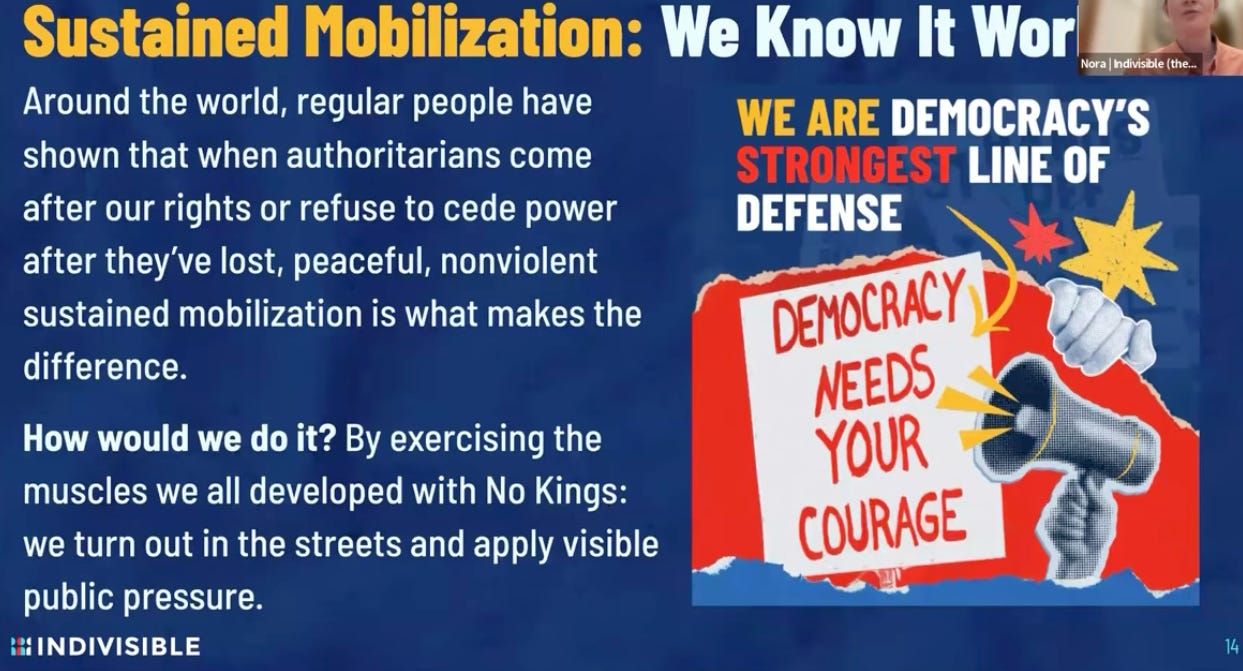
First: Movement building, which means training as many people as possible to get them ready to respond. Much of this is taking place on mass Zoom calls under the banner of “Hands Off Our Vote,” led by Indivisible and the ACLU, though there’s also a lot of parallel work pulling people into being election workers or legal monitors as well. Indivisible’s Election Protection 101 video has gotten 6,800 views so far; Election Protection 201 has gotten 4,000. These are not reassuring numbers, and mass Zoom calls are a very limited kind of training. Nevertheless, perhaps the best way to get involved in election defense if you aren’t already in an organized group is to go to Ground Control to find volunteer opportunities near you.
Second: Voting, which includes everything from pulling more people into the election through efforts like National Voter Registration Day (September 15), targeting local election officials for their courage in withstanding federal interference (Election Heroes Day on October 20), voting early (the No Kings coalition has announced October 17 as Vote Early Day), and engaging local businesses to get them to pledge to defend free and fair elections.
If predictions of a Blue Wave come true, then we may never need to get to step three. Indeed, the bigger the Democratic turnout, the greater the likelihood that Republicans will do the right thing and concede to reality. But California takes weeks to count ballots and there may be close House races elsewhere, creating ample opportunities for the Election-Denier-in-Chief and others to make false claims and agitate against the evident outcome.
Third: Escalated mobilization (also known as “all in”): This where everything gets tricky. In theory, some kind of trigger event will make it obvious that the time has come to go to the streets en masse. There’s a whole variety of possible scenarios: the Feds could seize ballots in selected districts, claiming that people have voted illegally; or a foreign adversary could successfully hack local election systems, or just create a power outage disrupting voting, or be falsely alleged to have done so, and then the Feds could call for voting or counting to be halted; or Trump could intimidate local officials into delaying the certification of results; etc. Or some new kind of gambit involving AI that we haven’t even imagined yet could throw elections into confusion. (The Freedom Trainers have an 83-page handbook outlining a great variety of scenarios along with examples of how pro-democracy forces in other countries have responded to them. Good luck sleeping well after reading through it.)
Whatever the trigger, local, state and national organization leaders will then make a call urging immediate mass action to stop business as usual. And unlike the No Kings rallies, this will require maintaining an ongoing, nonviolent presence in public spaces, potentially escalating up to a general strike. At the same time, calls will be made to get election officials, Democratic and Republican electeds, business and civic leaders and international watchdogs to speak out and join in. Then somehow we make it to January 3, 2027 when the House of Representatives reconstitutes itself with a full slate of duly elected Members.
Got it? Well, I have questions. 1) Who will be making the decision to go “all in”? No one will say publicly. I suppose this is for their safety, but I wonder if millions of people in the streets are ready to take guidance from leaders whose names they don’t know. Lech Walesa didn’t exactly hide his face when he and his colleagues occupied the Gdansk shipyards. 2) How will demands be conveyed to the relevant authorities? Again, not clear (see #1). 3) If the Trump administration refuses to concede, then what? And again, how are we deciding?
Well, as Donald Rumsfeld said, “You go to war with the Army you have, not the Army you might want or wish to have.” Maybe the opaque group operating behind the scenes to coordinate this work will emerge into public view like a “People’s Election Defense Squad” and America will get a taste of popular democracy in action. Maybe a couple of governors step forward to steer the movement. Maybe, like the GenZ activists in Nepal who overthrew their government in 2025, we all get on a Discord channel to hash things out (just kidding).
In 2020, there was open planning done by the “Protect the Results” coalition that enlisted hundreds of organizers in advance of the November election to be ready to rapidly scale up a national day of protest if then-President Trump disrupted it. By mid-October, more than 100,000 people had signed up and there were more than 245 events already mapped out. But when Trump indeed tried to prematurely declare victory on Election Night, the shadowy leaders of that group made the rapid decision to stand down. (Details here and here and here.) The rest of the post-election battle was fought in the courts and by a tight-knit group of organizers working with local groups in a few key states. All went well…that is, until January 6th surprised everyone.
We’re in a similar boat now, except that this time there are no adults around Trump telling him why he can’t do whatever he wants to stay in power. Good luck to all of us.
Of Note
--Rep. Maxwell Frost (D-FL) has just opened a new kind of local Democratic office in Orlando. “Organizing Hub will be a year-round headquarters that will help campaigns no matter how big or small,” he says. “It will also be a community space where we plan to host artists, pop-ups, canvasses, rallies, and so much more. Finding office space is difficult for campaigns, especially smaller ones. This space will give our endorsed candidates an opportunity to work out of a co-working space that has what they need to be successful. It will also be available to our Union friends + community orgs.” More like this, please!
--The New Yorker’s Emily Witt produced a long and moving feature article on “What Happened in Minneapolis,” which purports to be about what it was like to live through Operation Metro Surge and its aftermath, and while she bring lots of fresh detail to the story of Renee Good and Alex Pretti, somehow there isn’t a single word in her 12,000-word story about the organizing that led to the city-wide general strike of January 23. Less like this, please!
End Times
If you even remotely think reincarnation is possible, maybe don’t click here.
How about saying this: “We need to pair institutional and legal strategies with mass organizing and big tent strategies to help ensure that lawful outcomes are respected.” in straightforward terms someone who hasn’t thought about it much and is in a hurry can grasp immediately? And get a clear, concise primer video on how Minneapolis organized (as opposed to the story you mentioned) in front of as many eyes as possible? How? Ask Don Draper, or whoever does marketing for Grand Theft Auto. Sorry, but I don’t think we can look to foundations for leadership on this. Maybe for money. But only maybe. Perhaps funders could pay for regular folks from Minneapolis who organized their block, their school, their workplace, to train their counterparts - in person - in every city and state. I wish we could take a page from India’s cockroach movement, but I don’t know how to make that happen.
Many other unions across the country, and at the highest levels, have been talking about a general or social strike if Trump defies the Supreme Court.