
ICE is Feeding the Whirlwind
Plans for new concentration camps to hold ICE detainees, on top of the assualt on Minneapolis, are triggering rising local opposition and creating new potential fissures in the Republican base

Three weeks ago, the Washington Post was the first to report (gift link) on the details of a draft solicitation from US Immigration and Customs Enforcement (ICE) to drastically expand the immigrant detention system by taking over and renovating existing industrial warehouses to channel newly-arrested detainees into processing sites that would feed into seven large-scale centers holding 5,000 to 10,000 people each located near major logistics hubs. Sixteen smaller sites would hold up to 1,500 people each. Last April, ICE acting director Todd Lyons told a border security conference that “We need to get better at treating this like a business….Like [Amazon] Prime, but with human beings.”
Now Lyons’ crude vision is coming into focus. As the Post noted a bit too drily, “concentrating detainees in warehouses would create its own logistical problems. Such structures are designed for storage and shipping, not human habitation. They tend to be poorly ventilated and lack precise temperature controls — and, because they are typically located far from residential areas, they may not have access to the plumbing and sanitation systems needed to support thousands of full-time residents.”
So, let’s use clearer language. While ICE’s plan refers to warehouses, these are better described as “concentration camps.” And no, I’m not being hysterical. As journalist Andrea Pitzer writes in her essential history, One Long Night, “a concentration camp exists wherever a government holds groups of civilians outside the normal legal process—sometimes to segregate people considered foreigners or outsiders, sometime to punish. If prisons are meant for suspects convicted of crimes after a trial, a concentration camp holds those who, most often, had no real trial at all.”
Why do we associate the term “concentration camp” with mass death? Because whenever governments have coercively removed people from their homes and concentrated them in confined areas where they could be easily controlled, stress, neglect, hunger, disease and death have followed. The Germans got their ideas for concentration camps from similar programs run by Spain in Cuba during the Cuban war of independence from 1895-1898, Britain in South Africa from 1899-1902, and by America in its creation of “reconcentration” camps in the Philippines in 1901, Pitzer notes.
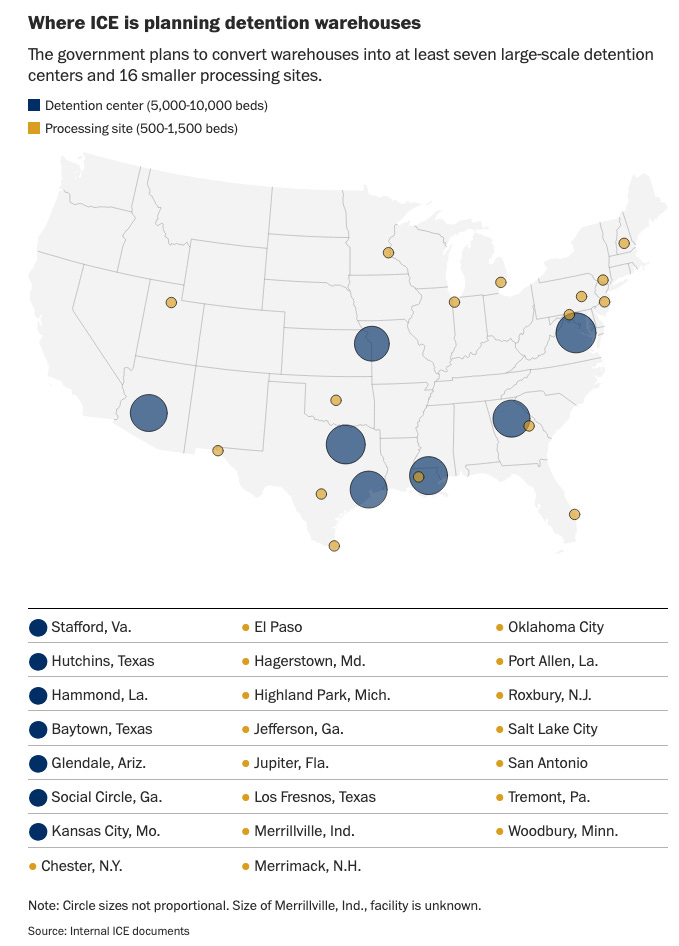
Will local officials and residents let ICE build these new concentration camps? NIMBYism, rather than moral outrage, may well be the force that stops some of them from going forward. For example, a few days after the Post article appeared, the City of Social Circle, Georgia, a Republican-dominated town 45 miles east of Atlanta, posted a notice on Facebook saying that its mayor and city council were “unequivocally” against siting one of ICE’s mega detention facilities in its environs, noting how it would strain local water and sewer facilities and possibly endanger public safety. A few days after that, “One Circle Community Coalition,” a local civic group formed last year to improve communication between city officials and residents as concerns about data centers has risen, pulled together a town hall attended by 120-150 people. Residents argued that the facility would have an unsustainable impact on its infrastructure, that it would attract outside protestors (on both sides) and that it would be only 4,000 feet from a new elementary school. Many also said they had no problem with ICE building these facilities, but just not in their backyard.
But that was before Renee Nicole Good was shot by ICE agent Jonathan Ross in Minneapolis last week. Now most of America is paying attention. We’re in a whirlwind moment.

ICE isn’t just a NIMBY problem
In Chester, NY, a small town in in rural Orange County, about an hour northwest of New York City, the news that a local 400,000 square-foot warehouse formerly occupied by a Pep Boys was going to be one of the few ICE processing centers located in the Northeast set off a firestorm of public protest as soon as it became public. Back on January 5, the local town supervisor, Democrat Brandon Holdridge, told Daily Voice Chester that town officials had received no advanced communication from the federal government before learning about the plan in the Washington Post. He said he was strongly opposed to it, given “well-documented abuses and illegal actions” by the Department of Homeland Security. He also expressed worry about the increased traffic, infrastructure and safety challenges an ICE facility would impose on Chester. Rep. Pat Ryan, a Democrat who represents the area, also expressed his opposition. Even the county executive Steve Neuhaus, a Republican, who recently won re-election 60-40%, told News 12 that he had concerns. “The federal government is hunting people down,” Neuhaus said back on January 2. “They say they’re mostly bad people, but if there are families with children, that’s a problem. We owe it to ourselves to come up with a better solution than to round them up as cattle in a temporary center in a warehouse.”
Monday night, I drove up to Chester to attend the monthly village board meeting, joining roughly 400 people who responded to a call from local faith, immigrant and civic groups to protest the planned center. Anticipating a big crowd, village officials moved the meeting from its regular location at city hall to the Chester senior center, and indeed, an hour before its scheduled start a long line of people stood outside in the freezing cold waiting patiently to get in. About 200 people were allowed into the meeting before it reached capacity, while a similar number demonstrated outside and waited for seats to open up.
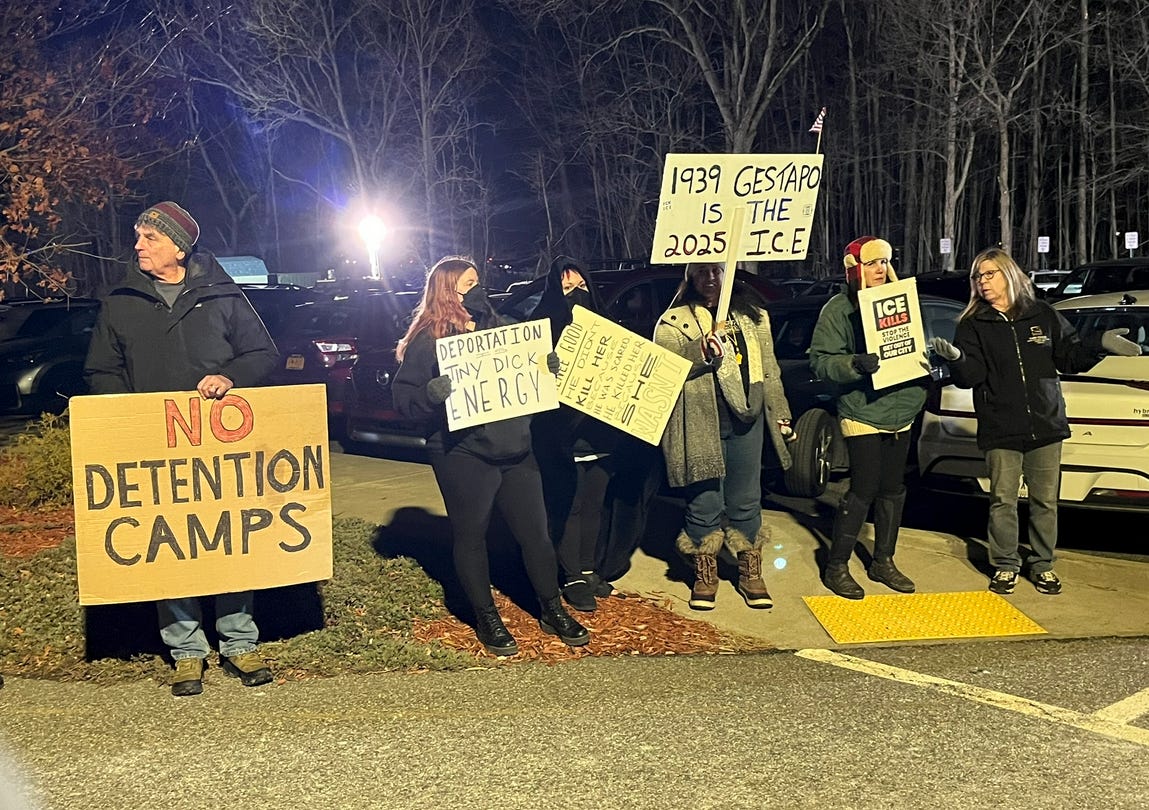
Chatting with attendees before and during the hearing, it was clear that a variety of group organizing in the area had pulled their members to the event. In addition to a large number of Chester residents, there were people connected to Indivisible groups in nearby Warwick, Greenwood Lake and Goshen; members of Lower Hudson Valley DSA; For the Many (a power-building group focused on tenant organizing, affordable housing advocacy, climate justice, and organizing Amazon workers in the Hudson River cities of Poughkeepsie, Newburgh, Kingston and Beacon), and hipsters from Cold Spring. One middle-aged woman told me that she and a few friends had gathered up the remnants of several grassroots “postcarding circles” and turned them into their own micro-organizing group.
The meeting started with the village’s mayor, Tom Bell, reading a statement he had earlier released explaining that while he understood there was much interest in ICE’s purported plans, to date they had received no official communications and therefore the topic wouldn’t be on the official agenda for that night’s meeting. But then he and his councilmates made quick business of their usual reports on town management, and within just a half hour the floor had be opened for short statements from a long list of Chester residents and nearby neighbors, all deeply opposed to letting ICE in.
Judging from those statements, as well as the response of the audience, something has shifted in how people are thinking about ICE and the whole apparatus of government coercion that the Justice Department, the FBI and the Department of Homeland Security has been building and deploying. People didn’t just talk about not wanting an ICE detention hub in their town because it would burden their roads, sewers and water systems, or turn their town into a center of national attention. Repeatedly, they spoke out against allowing a “concentration camp” to be built, about the “Gestapo” tactics of ICE, and about how an ICE center would turn Chester from a community that prides itself on being welcoming to all (and once a stop on the Underground Railroad) into a place of surveillance, fear and hiding. People old enough to remember WWII as well as young parents were making the same point. “We are not Germany, when other people looked away when concentration camps were being built in their towns,” one older woman said. (Sorry, but those links all go shaky handheld iPhone videos I captured; sound quality is meh.)
Not only that, in the wake of Minneapolis, more people are making the connection between ICE’s violations of the civil rights of immigrants and how this paramilitary force could easily be turned against anyone. Michael Sussman, a local civil rights lawyer who ran for county executive on the Democratic and WFP lines, getting 40% of the vote, told the Chester audience, “We cannot extend in any way, shape or form President Trump’s ability to entrap, imprison his enemies, whoever they may be today or tomorrow. Today they may be immigrants. Tomorrow they may be people in this room….I was here when the industrial park was constructed. It was not constructed for a concentration camp.” He sat to huge cheers.
New Polling Bears This Out
A new YouGov poll conducted from January 9-11 shows that ICE is now in serious trouble—with two-thirds of those surveyed saying that they’ve heard “a lot” about Good’s killing. Here are some key findings:
By a margin of 68% to 17%, the public supports creating stricter recruitment requirements for ICE agents.
By 64% to 20%, the public opposes ICE agents entering K-12 school campuses.
By 58% to 29%, people support criminally prosecuting any ICE agent who kills someone, with 53% specifically agreeing “the ICE agent should face criminal charges for shooting the woman in Minneapolis.”
A near majority, 48%, favors reducing ICE’s size and funding, while 37% oppose that. Sixty-one percent think ICE often or sometimes uses “unnecessary physical force against immigrants who are not authorized to live in the U.S,” while just 26% disagreed.
Sixty percent said they think ICE often or sometimes “uses unnecessary physical force against U.S. citizens who have not committed immigration or customs violations.”
Fifty-three percent say it is “too forceful” while 24% think its tactics are “about right” and 12% want it to be more forceful.
And by 55%-31%, people think ICE officers should not be allowed to wear masks that hide their identities while making arrests.
The bottom line: for the first time, a plurality of Americans favor abolishing ICE (46%-43%).
Of course, party identity explains a lot of these positions, but even 14% of Republicans favored criminal charges for the agent who shot Good, 36% of Republicans thought ICE should not be allowed on K-12 campuses, and 35% of Rs said they thought it often or sometimes used unnecessary force against immigrants who are not authorized to be in the US.(The poll’s margin of error was =/- 3.9%.) The Searchlight Institute, a new think-tank of self-styled Democratic moderates, is already warning that Democrats should shy away from talking about abolishing ICE in favor of “reforming” and “retraining" it, but IMHO it’s far too soon to adopt such conciliatory language when the agency is clearly out of control and probably unreformable. Most of the people saying “Abolish ICE” clearly mean getting rid of something that’s been turned into the American Gestapo. You don’t reform a Gestapo, you eliminate it and replace it with something that abides by the law.
—Also, take note; Trump has lost Joe Rogan on this. Tuesday, he said, “You don’t want militarized people in the streets just roaming around, snatching up people — many of which turn out to be U.S. citizens that just don’t have their papers on them.” He added, “Are we really gonna be the Gestapo, ‘Where’s your papers?’ Is that what we’ve come to?”
—A coalition of Minneapolis labor, faith and community groups are now calling for a general strike on Friday, January 23rd across the city. They are demanding that ICE leave the state, justice for Renee Good, and an end to all ICE terror.
In Other News
—Don’t miss Gideon Lichfield’s Futurepolis post on “Mamdani’s bold experiment in participatory democracy.”
—Writing at The Great Progression, California tech veteran Peter Leyden thinks that despite the evident rise of “Right Tech” (as seen by all the oligarchs riding the Trump gravy train), the majority of the tech world still leans left and is due for a resurgence. His reasoning is tempting; essentially, he argues Trump is screwing up the country and wrecking the Republican brand even worse that Herbert Hoover did 100 years ago, clearing the path for a new way forward. Maybe? Perhaps I should write a whole post about Leyden’s theory. In the meantime, give it a read.
End Times
When you really need to get away.
I couldn't understand why people didn't get this when they built alligator alley. It was pretty obvious that the plan wasn't to have empty jail cells.
Great edition. Also, here's a good "Freeze ICE" piece from Antonia Scatton: https://open.substack.com/pub/reframingamerica/p/a-call-to-freeze-ice?utm_campaign=post&utm_medium=email