
This Can't Wait: What it Will Take to Stop a 2026 Power Grab
An essential memo by a top progressive organizer is now public. Go read it. And get ready.

While most people are preparing for 2026 to be a normal election, that probably won’t be enough, given all the signs that the Orange Cheeto and his minions have been giving. A few months ago, to get organizers’ heads around the real likelihood that the regime is going to try to create enough chaos, legal uncertainty about results, and manufactured doubt to suspend the certification of the fall midterms—a pure power grab to hold the reins of power in Congress indefinitely—Minnesota organizer Doran Schrantz wrote a 14-page internal memo called “Act Free to Be Free.”
A week ago, journalist J. Patrick Coolican of the Minnesota Reformer got ahold of Schrantz’s memo and published this in-depth story about it, with her permission. The full memo is here courtesy Coolican and it’s quite bracing. I strongly urge you to go read both and start discussing and digesting them with whatever groups you are involved with.
As you will see, much of the memo is about connecting the dots illustrating the regime’s power-grab planning and then outlining a very robust form of the usual “protect the vote” work that people have been doing for years:
preparing local teams of lawyers to do rapid response filings for emergency injunctions,
preparing political and civic leaders to be ready to speak out,
mapping which election workers and administrators will need support (or opposition, if they are election deniers), and
preparing local groups in key places where problems may be expected to flare up.
It’s the bottom third of the memo, which discusses scenarios for fighting back in real time and mass mobilization, that is most helpful in opening up a critical discussion that up until now has mainly be held behind the scenes (and/or fueled by apocalyptic clickbait artists). What do we all need to do to be ready for this? Schrantz envisions large numbers not just of pre-positioned lawyers, but also trained accompaniers at polling places like the 30,000 constitutional observers who helped stop ICE in its tracks last winter in her state.
Finally, she gets to the hardest part, in case all the previous steps don’t ensure that the core democratic institutions surrounding voting and certifying elections hold up. She writes:
We must also prepare for a harder scenario. If duly elected leaders are not seated. If Congress is suspended or its constitutional role is nullified through delay. If the results of a free and fair election are simply refused. In those moments, the courts will be too slow. The lawyers will need time we do not have. The institutions we are counting on to hold will be precisely the ones under attack. In that scenario, civil society cannot wait. It must move, and it must move with the speed,scale, and clarity that only comes from preparation done long before the crisis arrives.
Minnesota was the proof of concept of this approach. In just two weeks, a massive number of Minnesotans joined the state’s first general strike in more than 40 years. Schrantz notes, “When the strategic conditions shift, what was once impossible becomes possible, but only if people and leaders are already prepared. The months of nonviolent direct action, constitutional observer training, and investment in decentralized community leadership made it possible. That synthesized with an acute crisis, and it moved.Given the stakes for our country and our lives, this needs to be the floor. Not the ceiling.”
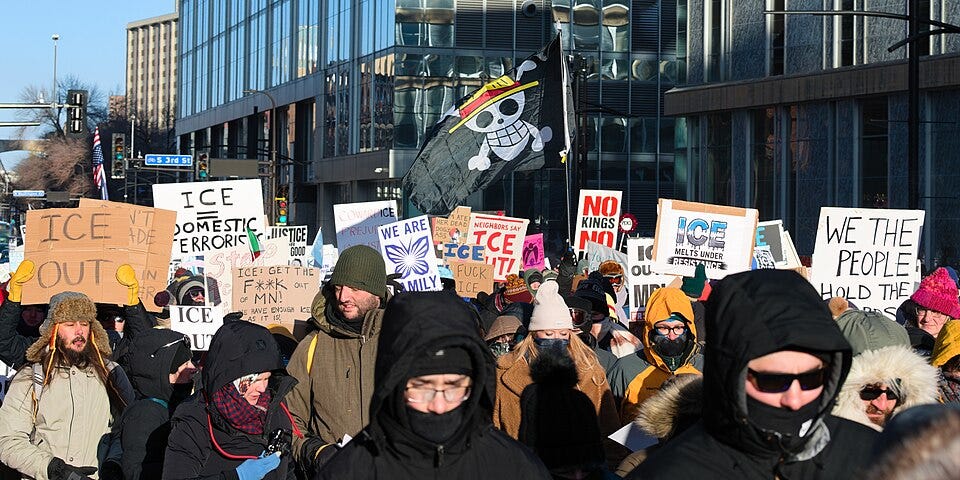
This requires preparation now. Honestly, it was required long before this, but it’s been insanely hard to get Democratic and progressive donors, organizations and leaders to believe that they had to invest in preparing for such a scenario. As Schrantz notes, “If they try to take our right to free and fair elections, we cannot have a ‘day of action.’ We need to suspend the daily order of things.” That includes coordinated work stoppages, business closures, and economic withdrawal, to put pressure on business elites and corporations.
All the petty infighting right now about which faction of the Democratic party should get the upper hand, etc., etc., pales in importance to this essential task of preparation. Last winter in Minnesota shows that mass nonviolent resistance to Trumpian fascism is possible and can be strong enough to win. But most of the money that’s been invested in community organizing and infrastructure the last few decades has gone to swing states. Which means there are many places—including but not solely blue urban cores in red states—that could be flashpoints for election meddling this fall where the organizing layer is thin. As the recent flareup of violence around Delaney Hall showed, there are many reasons to worry that either well-meaning protest or agents provocateurs could trigger the sort of scenes that would play into the hands of the power-grab. So not preparing now is not an option.
If you are in a power-building organization or network, you probably already are engaged or starting to engage on this work. But if you’re one of the many “irregulars,” the wonderful amateur volunteers who have shown up time and again as the democracy crisis in America has worsened, a good way to get oriented to your role is to join Indivisible’s Hands Off Our Vote national kick-off call on Thursday July 30 at 8pm EST.
In addition, Freedom Trainers has this handy set of election defense resources including an in-depth election defense scenario guide.
Sorry to disturb your summer! It’s still important to recharge your batteries. But forewarned is forearmed.
One thing I've been wondering (and not certain on this) is whether blue cities need to train and set up police voter protection squads to help confront ICE agents or Proud Boys, or others who would try and deter people from voting. It's obviously complicated, but I think should be considered as part of the scenario.