
Why We Need a Bigger Map
How the deep investment in year-round state-level organizing is paying dividends in one state, and why the old-fashioned "battleground" map isn't helping.

Two things caught my attention this past week. The first is an article in the Minneapolis Star-Tribune by Briana Bierschbach that describes how the anti-ICE community defense organizing of last winter has generated a wave of new grassroots involvement in the Democratic-Farmer-Labor party (the formal name for the state’s Democratic party). The second is a Medium post by movement strategist Ash-Lee Woodard Henderson about how, in the fight against rising authoritarianism, we have been collectively mis-served by the widespread focus on battleground states.
Together, these two pieces share a common signal amidst all the noise coming at us from all directions: consistent and long-term investment in local community organizing needs to be of at least equal, if not greater, importance than short-term spending on media, messaging, polling, paid field, etc.
First, the story coming out of Minnesota. Here are some key quotes from Bierschbach’s report:
For decades, Democratic organizers in Minnesota have searched for a way to turn moments of outrage into lasting political engagement. Many believe Operation Metro Surge did just that. A sprawling volunteer network that sprang up almost overnight to help immigrant families is now feeding people into the state’s DFL political infrastructure as precinct chairs, convention delegates, campaign volunteers and even candidates for office. Organizers say that transformation wasn’t accidental: Years spent building neighborhood networks and organizing infrastructure meant thousands of first-time volunteers had somewhere to go once the immediate crisis subsided….
For Carl McBurney, the first step was standing outside a school. The south Minneapolis father of two had always voted and followed politics, but activism had taken a back seat to working and raising a family over the last decade. When the immigration crackdown started, he signed up for a school patrol in his neighborhood. “January started with just being in a school patrol trying to make sure kids felt safe,” he said. “It snowballed from there.” Months later, McBurney had attended his first DFL precinct caucus, became a precinct chair and joined his neighborhood association’s board. The experience changed how he thinks about civic engagement. Instead of jumping in only when there’s a crisis, he said, he’s trying to build the relationships that make communities more resilient before one happens. “One person can make a huge difference by just establishing some kind of communication across the block,” he said….
Even in Minnesota, where voter turnout, volunteerism and civic engagement already rank among the nation’s highest, organizers said the response to Operation Metro Surge surprised them. TakeAction Minnesota [a progressive advocacy group] trained more than 2,000 volunteers to observe and document law enforcement activity, coordinated roughly 3,000 patrol shifts a week at the height of the crackdown and helped raise $4 million to keep families fed and housed. Hundreds of people began joining nightly Zoom calls that previously drew 40 or 50 participants. [Amanda] Otero [its co-executive director] said groups like TakeAction weren’t creating new organizations from scratch during the crisis. They were plugging thousands of new volunteers into networks that already existed. Organizers had spent years building toward this moment. After George Floyd’s murder drew enormous demonstrations in 2020, Otero said many struggled to convert that energy into sustained organizing, a challenge compounded by the pandemic. Operation Metro Surge found Minnesota’s organizing infrastructure better prepared. Now, some of those volunteers-turned-activists are connecting with a broader network of groups working to flip the state House to DFL control as well as the rural First District seat in Congress, she said.
The Minnesota DFL Party also trained 10,000 observers in 48 days and tens of thousands more went through trainings through other organizations, said party chair Richard Carlbom. The opportunity was clear, he said: “How do we get you to go from that protest on a roadside or a bridge to door knocking in September?” The party reported record turnout at February’s precinct caucuses, and more than half of the people who attended the DFL convention this spring were brand new to the process, drawn in by the immigration crackdown.<<
Several points to underscore:
The anti-ICE community defense work didn’t come from nowhere. It was built by and on top of existing community organizing networks, like the more than 90 immigrant, labor, legal, faith and community organizations that make up the state’s Immigrant Defense Network.
Something like 30,000 people got trained to be constitutional observers in response to “Metro Surge,” along with thousands more volunteers who signed up to deliver food and give rides to at-risk families and provide other kinds of direct aid. That’s almost one percent of the state’s adult population.
The DFL didn’t stand apart from this work; it was directly and deeply involved, as exemplified by its work doing constitutional observer training.
Finally, unlike many state Democratic parties, the DFL has a relatively open infrastructure and culture of inclusion, centered on a multi-tiered caucus and convention process for endorsing candidates (the state GOP is similar). Any eligible voter can attend a precinct caucus, put forward resolutions, and run to be a delegate at the party’s convention. Though candidates can bypass that process and get on the primary ballot on their own, the DFL endorsement carries real weight with voters and comes with significant support from the party.
What this all means is the path from activist to party volunteer to influencing power isn’t as steep as it is elsewhere, in part because ordinary people can see how their involvement can make a difference (rather than parties dominated by money or powerful insiders). Likewise, because the DFL is so porous, it has made sense for organizing groups that do ongoing power-building to invest real effort in getting their own activists to get more involved in the party. For some people, this means the convention endorsement process is “too chaotic” or too malleable to the desires of the most politically engaged; others disagree and say this is what makes the DFL a “living, breathing political party.”
No One is Getting Left Behind This Time
If you’ve tuned into any movement-wide mass Zoom meetings called to respond to some Trump outrage or get people revved up for the next big rally, you are probably already familiar with Ash-Lee Woodard Henderson. Her good cheer and southern drawl are a comfort to many. She’s also an important strategist for whatever you want to call the resistance – the Defiance, the No Kings coalition, whatever – though a lot of her work goes on behind the scenes. I don’t see her doing a lot of movement critique in her public work, befitting someone who is in the thick of trying to knit together the biggest possible coalition for us to face the polycrisis we’re in.
So her post from July 29 on Medium caught my eye. Titled, “The Battleground Map is Lying to You,” it reads like a rebuke of a whole generation of Democratic/progressive strategy. She starts by reminding readers of the blatantly racial power grab underway in the South in the wake of the Supreme Court’s Callais ruling that eviscerated the last standing leg of the Voting Rights Act and decided that drawing election districts to remedy racial discrimination against minorities was unconstitutional. In Tennessee, her home state, the majority Black city of Memphis, which was previously the heart of the state’s only majority Black congressional district, has been sliced into three pieces, destroying that community’s main power base. But, Woodard Henderson, writes, “there’s one simple reason most of us aren’t still livid” about this:
“Tennessee isn’t on the map. The one we’ve all been handed, the one that gets pulled up on cable every two years, with the same seven or eight states colored in: Pennsylvania, Michigan, Wisconsin, Arizona, Nevada, North Carolina, Georgia. The battleground map. It decides where money goes. It decides where field organizers get hired, where doors get knocked, and where candidates fly in for rallies. If your state is on it, you matter. If your state isn’t, you’re “safe,” and safe means skipped, conceded.”
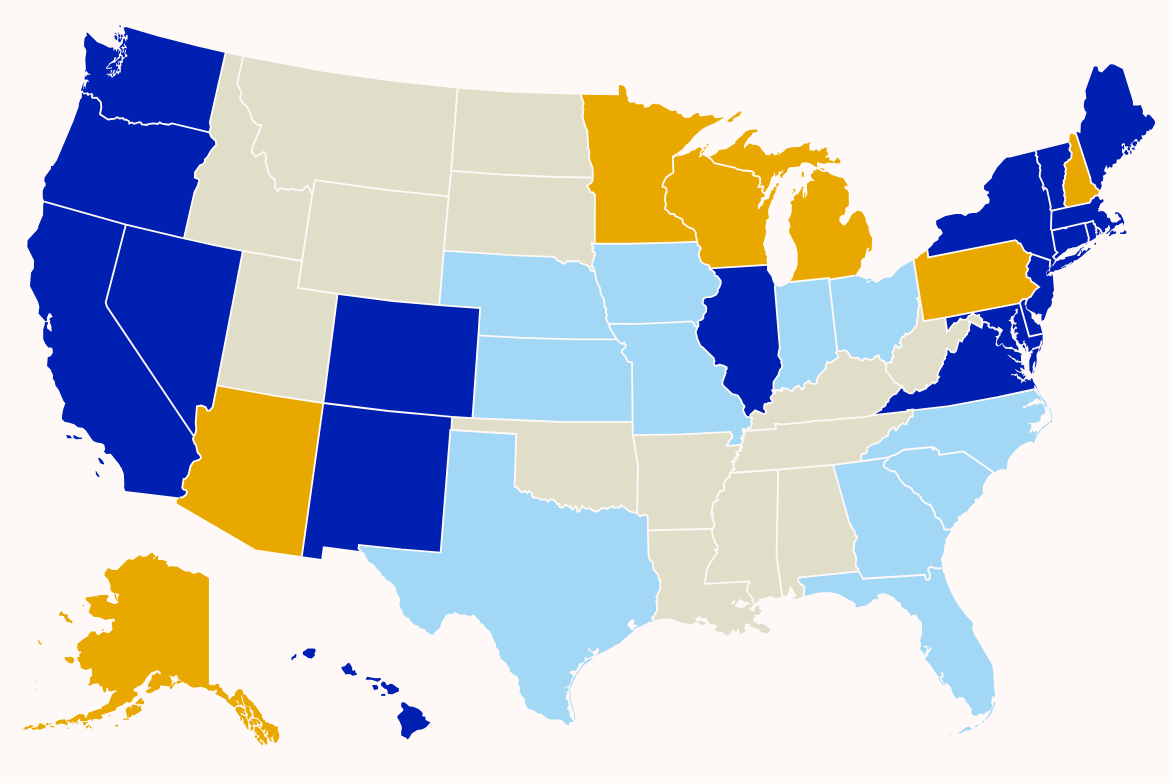
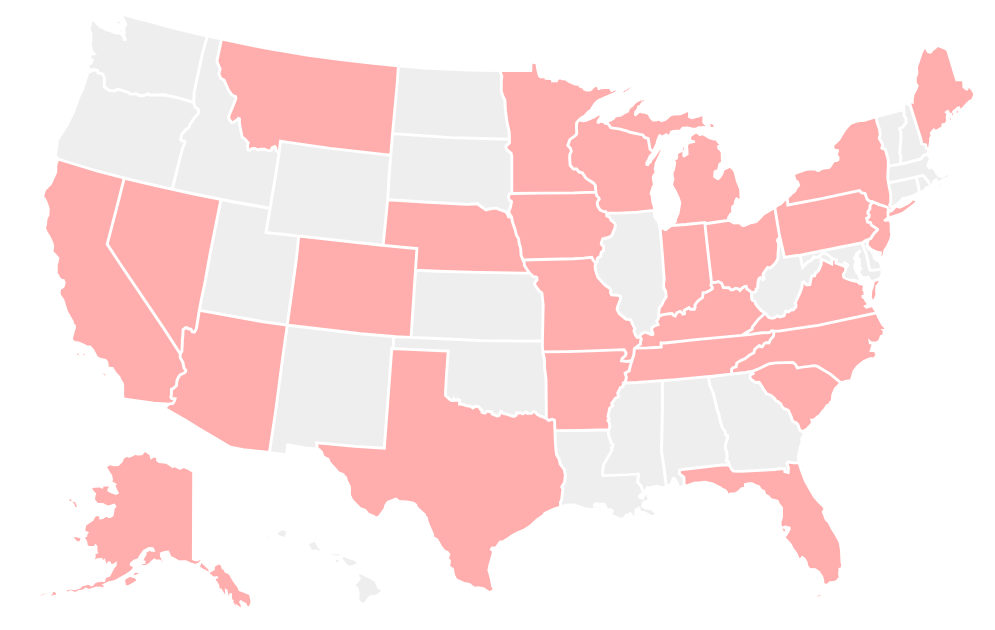
She goes on to point out that similar things have happened in other southern states where GOP-dominated legislatures and governors are taking advantage of the Callais ruling, including Florida, Louisiana, Alabama and Mississippi. So far, there’s only one state where the Republicans have backed off: Georgia. That’s where Black-led organizations and coalition partners turned up the heat enough to make Republican state legislators wary of redistricting now. And it’s not a coincidence that the pushback in Georgia was so strong—it’s been on the battleground map for years, drawing lots of outside investment.
Woodard Henderson points out that there’s plenty of solid organizing that’s been going on for a long time in the neglected states, like the Memphis A. Philip Randolph Institute, Memphis for All, Free the 901, MICAH, Tennessee for All, the Tennessee Immigrant and Refugee Rights Coalition, and The Equity Alliance in Tennessee.
Collectively, if we want to make states like Tennessee and Mississippi and Alabama and Florida and Louisiana harder to attack by the forces of white supremacy, we must start prioritizing supporting groups like these in all of those states. The battleground is bigger. Our map has to reflect that.
—For starters, look to the Movement Voter Project and Oath.vote for pointers on how and what to prioritize when you donate to groups and candidates. See MVP’s Southern Plan and Oath’s Show Up for the South portfolio in particular.
Coda: Where Short-Termism Matters
While I’m making yet another pitch for long-term thinking by citing these two posts, there’s still a much shorter-term emergency on the horizon: the risk that November’s elections will be disrupted by Trump and his minions. Here again, Woodard Henderson is a useful guide. She’s taken the Voting Rights Lab’s Election Risk Heat Map and expanded its scope to cover all fifty states, not just the ones with close contests. Go here to see “The Whole Map” to see where your county fits in the larger picture (and let’s hear it for AI-assisted data munging, too!).
End Times
Yeehaw, indeed!
Time is another element to consider in mobilizing voters beyond the traditional battleground maps.
The best time to engage with people is when something happens that impacts their lives (a school closing, foodstamp cuts, a shooting...). It harnesses people's attention while the issue is fresh in their minds to establish a connection with them. It's timely, relevant and non-partisan. And once that connection is made, organizers can use that connection to engage and mobilize them over time.
Democracy Labs created MakeItFast.org for thispurpose. It is a free resource for progressive groups to quickly create an online channel to reach people affected by an issue. Think of a channel as an online version of a TV channel and that people can choose and subscribe to - anonymously (no phone number, no texts messages, no email needed).
Channels are hyper-local and any number of channels can be created for different issues or locations. Subscribers get alerts immediately on their phones or laptops. A 'call-in-radio' like features lets subscribers anonymously share their own updates with other subscriber to a channel. Ideal for reporting a local danger...
MakeItFast works for grassroots groups as there's no cost as with texting, and people do not share any information about themselves so they cannot be spammed by other groups.
Checkout this MakeItFast channel to see how this solution works:
How To Track ICE Deaths Despite Disinformation
https://thedemlabs.org/2026/08/05/how-to-track-ice-custody-deaths/
Questions? Email Deepak@thedemlabs.org