

A few weeks after the 2024 Democratic National Convention, New York Times Opinion columnist Zeynep Tufecki wrote a gloomy column (gift link) arguing that the age of mass protest was over. Not because people had stopped taking to the streets, but because the powerful had stopped responding, stripping protest of its power. “R.I.P. the era when big protest marches, civil disobedience and campus encampments so often changed the course of history,” she wrote. Reprising the argument she made in her seminal book Twitter and Tear Gas, she pointed out that while the Internet had made mass protests easier to convene, it had paradoxically also sapped them of their strength. On top of that, she wrote, the powers-that-be, be they urban police forces or university administrators, had also figured out that throwing the book (or batons) at protestors worked more often than not.
Such are the dangers of punditry. At least she didn’t write the single dumbest prediction of 2025, that of political writer Ross Barkan, who, the week of Trump’s second inauguration, wrote in the New York Times Magazine that the resistance era was over and now “accommodation and acceptance are the new watchwords.”
Still, the notion remains that protesting is futile. Perhaps even more today, as much of corporate and civic America has either embraced the Trump agenda, bent their knees, or maintained a careful silence, it’s understandable that ordinary people might feel that there’s no point in bothering to raise their voices.
Well, here’s a stab at showing how we know that mass protest does matter, in one unwieldy chart that I made with a bit of help from AI.
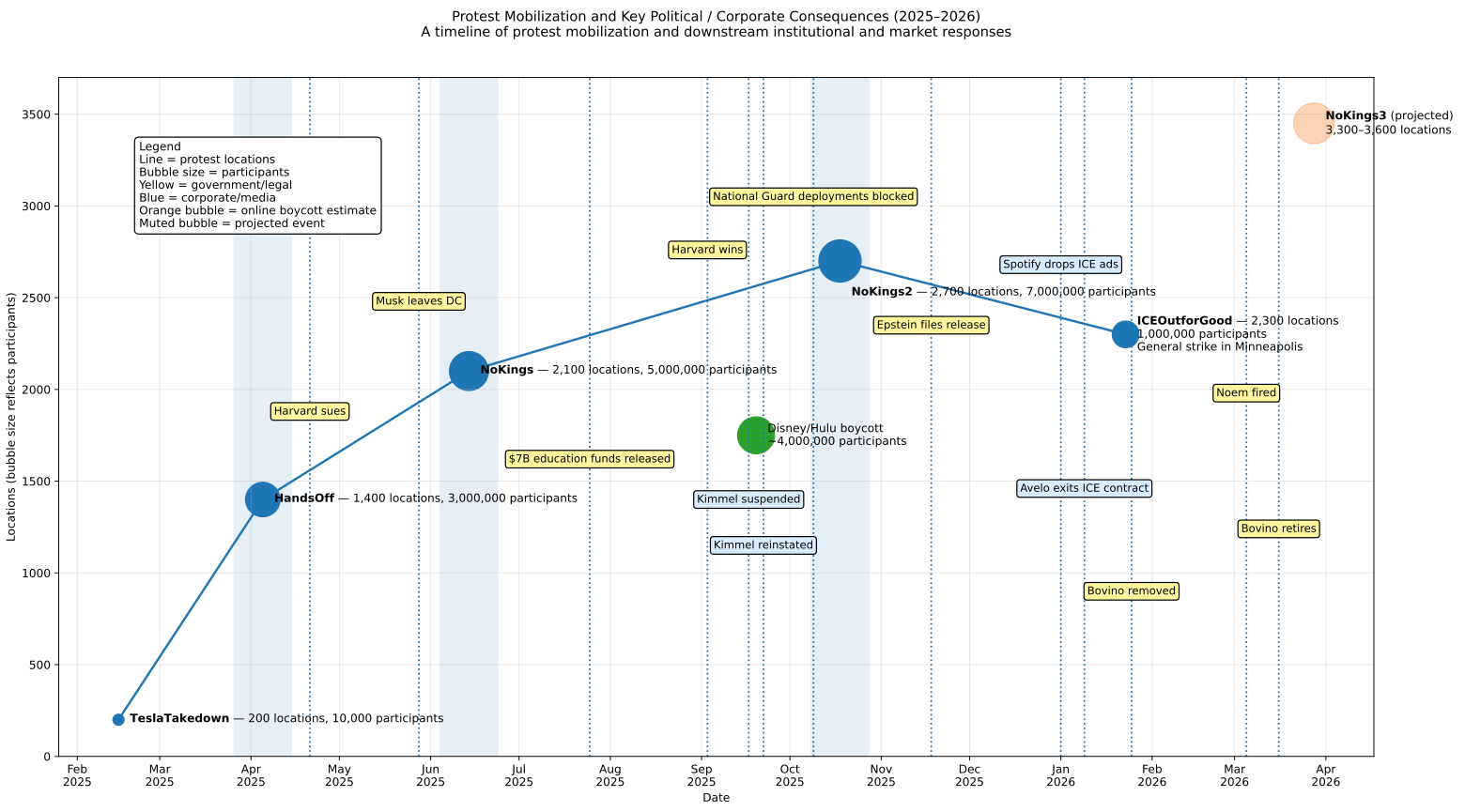
Here’s how to read this. The horizontal axis is the months since the Orange Cheeto started his second term. The vertical axis is for the number of locations reported for each of the major protest days of the last year. The size of each circle corresponds to the estimated number of participants. And the yellow and blue boxes describe particular governmental or civic actions that took place, often in reaction to public protest, with dotted lines connecting them to the calendar. Finally, the light blue bars shading each of the three big protest days are meant to indicate that these events took time to build up to.
Obviously, I’m leaving a lot of stuff out of the picture. There has been a lot of pushback on Trump in the courts. Some of his biggest or most outrageous attacks on federal workers or programs have been blocked or reversed. Same with some of his anti-immigrant actions. His tariff policies have met stiff resistance from foreign countries, the stock market, and most recently the Supreme Court, often leading to reversals.
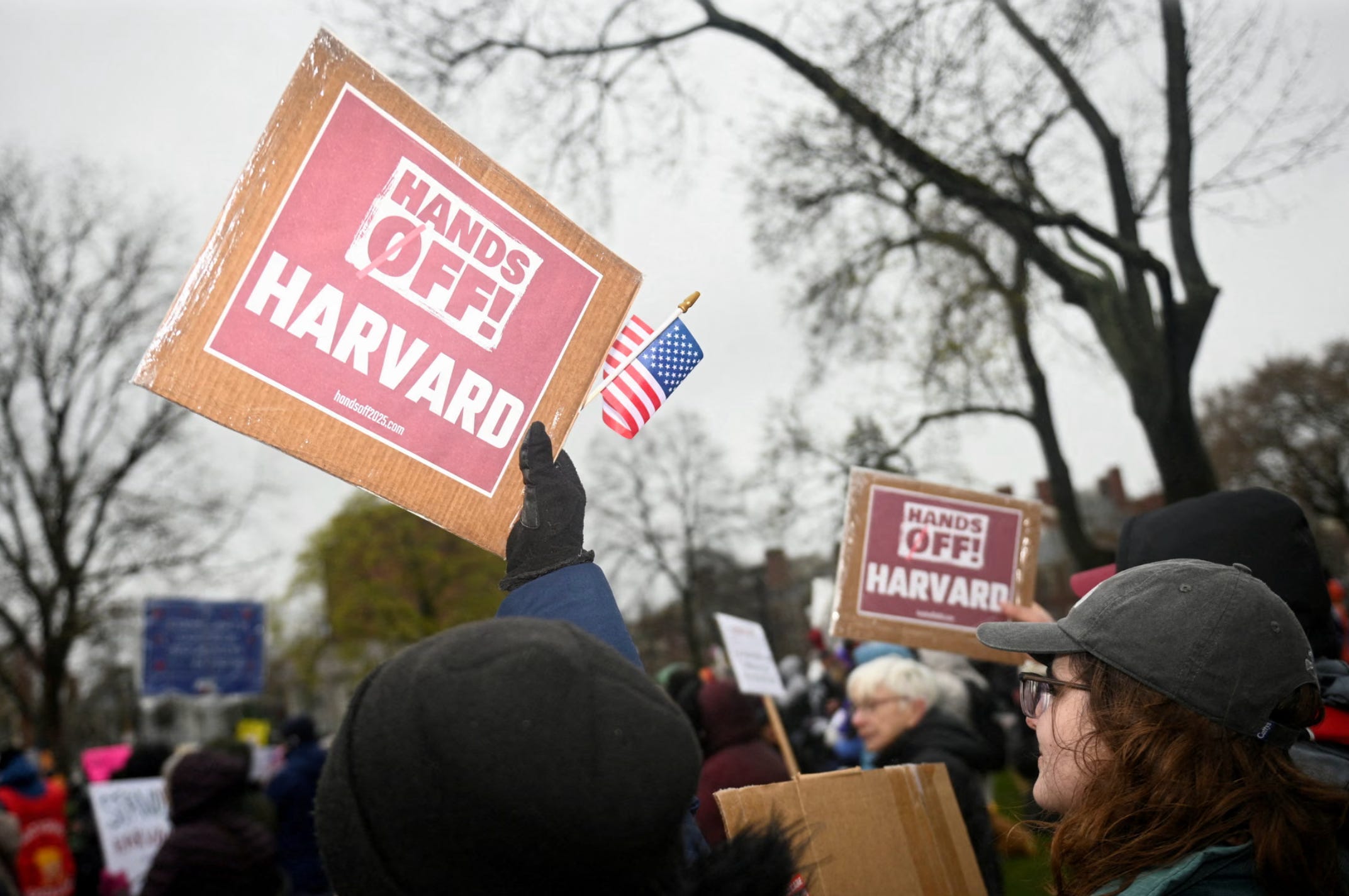
But the basic message, I think, is clear. Harvard didn’t make its decision to hold firm and sue the administration until after the first big Hands Off rallies of April 5, 2025, and there’s clear reporting showing that university administrators stiffened their spines in response to the rallies, which buttressed intensive organizing by alumni, faculty and students. Elon Musk’s standing in the Trump White House didn’t collapse on its own, it was accelerated by highly visible public protests at Tesla showrooms across the country, which drove down Tesla stock prices as well as the billionaire’s popularity. Republican senators didn’t complain about the Department of Education suspending billions in local school aid in a vacuum; those complaints came after the massive No Kings protests of June 14, 2025—which the Nonviolent Action Lab at the Harvard Kennedy School found spread much further into “Trump country” than anti-Trump protests in his first term. While the courts operate on their own timeline, it’s fair to say that judges also pay attention to the news and to public trends as well, and the rulings blocking Trump from deploying the National Guard wherever he wanted do take note of the significant public protests that took place against those deployments. Finally, Congress voted near unanimously to force the release of the Epstein files only after seven million of us turned out for No Kings 2 in mid-October.
Two additional points. Mass protests like Hands Off and No Kings are just the most visible parts of public action against Trump. There have been several successful corporate pressure campaigns, from the fight over Disney’s suspension of Jimmy Kimmel to the boycotts against Spotify and Avelo Airlines for collaborating with ICE. All three led to reversals by those corporate actors. (See Boycott Central for more info.)
And the intensity of protest is rising. While the three biggest days of protest were each organized over several weeks in advance, the “Ice Out for Good” rallies of the weekend of January 23-25 came together in just a few days. Notably, they took place in more locations than the first No Kings protests—another sign that the Defiance movement has grown local muscles across the country. I don’t think it’s a coincidence either that two of the most visible and awful people in the administration, ICE Barbie Kristi Noem and Gruppenfuhrer Greg Bovino, have been given the boot.
Now, as No Kings 3 approaches on March 28, it looks like it is on track to be substantially bigger than all the previous national days of anti-Trump protest. I’ve been watching the raw number of No Kings events listed on Mobilize go up each day since last Wednesday, and based on that trend expect the mobilization will reach somewhere between 3,300 and 3,600 locations. (This morning, the No Kings coalition put out a press release saying that it had surpassed 3,000 local events.) If attendance trends track the same way, that means there could be nine million of us in motion a week from this Saturday. That’s still not 3.5% of the population, nor does that indicate that the Defiance has pulled that many people into continuous organized action.
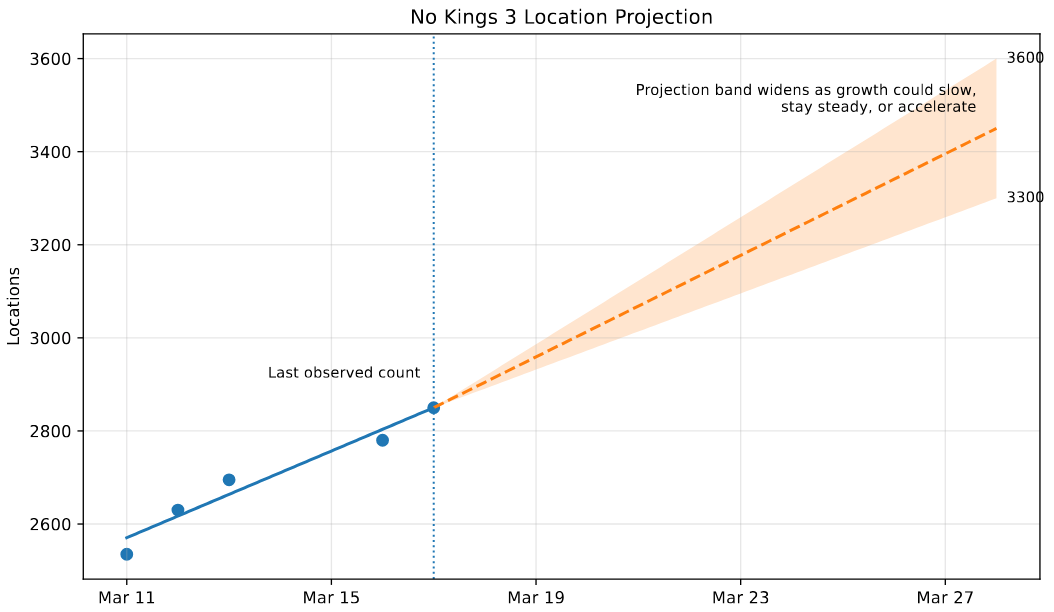
But the capacity to pull together roughly 3,500 simultaneous local rallies of varying size is a sign of growing strength. In many cases, the group or groups organizing a local No Kings 3 rally are onto their third time handling the logistics, as I discovered from querying members of the Indivisible Action Center Slack. On the other hand, Francesca Wander, a longtime Indivisible organizer who started with Indivisible San Francisco and is now with Indivisible Sacramento, told me she saw “Lots of smaller events popping up in smaller communities and towns, rather than necessarily joining the nearest large event.” She added, “Bigger isn’t necessarily better (although it’s definitely good) but even small groups of people coming out in communities and towns all across the country speaks volumes. Good things definitely come in small packages. Plus you don’t need a lot of experience or infrastructure to host a small event. Just a few bodies with some signs can have an impact.”
—Related: Historian and movement organizer Van Gosse offers some valuable thoughts on the differences between a mass movement and a protest wave. He writes, “My basic premises are that a mass movement exhibits both visibility and tenacity. A movement reaches “mass” when it becomes a visible presence, with which anyone can affiliate, in the daily life of a city, region, or nation. That kind of movement generates symbols that are instantly recognizable as personal branding—the peace sign in the late 1960s, for instance, later on Pride and Confederate flags, MAGA hats now. Beyond instant recognition, a true mass movement possesses staying power over time. Sweeping waves of protest, when crowds suddenly converge and surge into action, are a different, although undeniably powerful, phenomenon—think of the Occupy take-overs of urban space in 2011, or the nationwide explosion of outrage after George Floyd’s murder in May 2020.” But before celebrating, Gosse says to remember: “Trump’s enduring popularity should force us to confront that he has been leading a mass movement, and we are playing catch-up.”
Odds and Ends
--A new report from Oath.vote finds a quiet but significant generational shift is underway among Congressional House Democrats. While 85% of the 74 House Dems over the retirement age of 65 have announced that they are running for re-election, a “massive wave” of more than 210 challengers are primarying them. Collectively, those challengers have raised more than $20 million, a sign that this is serious (though if you dig into the data, most of the incumbents have bigger warchests than their challengers). More than half those challengers are under the age of 50, Oath found. The group, which helps campaign donors target their money where it can be most useful, says the divide inside the Democratic party is less about left vs center than how to fight. It adds, “Younger generations are delivering more combative and more populist messages, and Democratic donors are rewarding them for it like never before. We could see a wave of longtime incumbents lose their seats in upsets reminiscent of the AOC shock-win in 2018.”
--Emily Amick, a former Senate counsel to Chuck Schumer, makes the case for more investment in “the influencer economy,” noting that in 2024 one such person (with a big following but unclear political leaning) was offered $36,000 by a rightwing group to post a sponsored video and a leftwing group offered just $2.000. The person declined the bigger offer because she leans left, but in Amick’s view this tells “the story of the modern political social media economy in one anecdote.” Personally, I’m not convinced that the answer is to try to match the right in bribing people with big social media followings, and that isn’t quite what Amick is arguing for, to be clear.
I hope the Americans who march against tyranny on the 28th will keep things as non-violent as they can. Non-violence has a way better chance to succeed when you’re looking to tear down a regime. You’ve got to get the regime’s forces to join you in order to turn the tide. There’s no way you’re ever going to out-gun them. But if you can get them to join you, the regime will fall.
How do you get them to join you? Not with fists and bullets and bombs. They’ve got to be persuaded. You have to make them see that what you’re doing is right... And that their orders to stop you are wrong... And get them to join you. When enough of them are persuaded, everything gets turned around.
The marchers need to keep in mind that non-violent doesn’t mean non-terrifying. The regime is going to have to be scared near to death in order to put the levers of government back into the hands of the people where they belong. Their fear will have to be a more powerful motivator than their greed. When there are seas of marchers who are looking to take them down - seas large enough and angry enough - they’ll hand over the levers. They won’t run the risk of those seas boiling out of control and sending them to Davey Jones' locker. History shows that non-violence is way more likely to succeed, but it also shows that revolution is a game of fear.
Any sense of what the organizing “homes” are? Are these mostly Indivisible groups? Local communities that have developed an attachment through this process? I imagine it’s a combination of all of the above.