
Getting Ready for No Kings 3
Why it's so important to invite new people to join and then actively welcome them. Plus, more thoughts on why the US is bombing Iran.

The third “No Kings” day of national protests is March 28, in less than three weeks, and it is on track to be huge. The previous No Kings day on October 18, 2025 drew an estimated 6-7 million participants across 2,700 registered locations, making it one of the largest days of protest in modern America. From what I hear, based on the current pace of sign-ups, the No Kings coalition will exceed that number of registered events next week if not sooner. (If you know where to look in the Mobilize page source code you can see the raw number of events. It was 2,343 events as of 5pm Monday; Tuesday at the same time it was at 2,432.)
So, No Kings 3 is going to involve millions of us. Great. But the vast and growing pro-democracy movement in America has two key tasks to focus on as that day approaches and arrives.
Task One: Inviting New People to Join In
Back in the fall, I saw an internal movement survey that found that among the slightly more than half the public who said they disapproved of Trump’s policies, more than 7 in 10 said they had not been asked to participate in any action to make that feeling public.
Odds are, as a Connector reader, you either already knew this, or you’re currently trying to digest this new fact. But the dirty little secret about public participation in politics is how few people do it on their own. It helps enormously if someone asks! Indeed, that same survey also found that 55% of Trump disapprovers said they would attend a protest only with people they know.
Many progressive activists, who have developed their political views and commitments through a process of intellectual discovery, make the mistake of believing that that is how everyone becomes politically active. Sociologists who have closely examined the process by which people get active in political movements have found that social connections matter much more. Most people do not start out being politically active because of their commitment to a cause; they start out because a friend or acquaintance invites them to join in on something, they have fun and make friends, and then they get politicized into supporting the cause. To repeat something I wrote about this here four years ago:
Many people may care about an issue, but only a few get involved. Why is that? Ziad Munson, in his excellent book The Making of Pro-Life Activists: How Social Movement Mobilization Works, makes the following argument. People get involved in a movement when three things happen. First, they have to experience a direct, personal contact, through their social networks, to a movement organization. Second, they need to be at a moment in their lives where they are open to a personal change. This is what sociologist Douglas McAdam called “biographical availability.” And third, they have to actually participate in some form of initial activism—a rally, protest, meeting, counseling session or the like—which they enjoy and decide to continue doing.
Two things thus constrain who will get involved. First, the availability of sites of mobilization. These are often social settings like churches or other regular gathering places where a friend or acquaintance may invite you to participate in something political. If you live in an activist desert, those contacts won’t happen. This is one reason I constantly harp on our need for more places where progressives may serendipitously collide and rub shoulders with non-activists, and why the presence of thousands of local gun clubs, Bible study groups and home-schooling circles are such a boon to right-wing movements. The second factor affecting who may get involved is whether they are at a stage in life where they may be open to or need to find new connections. Being at a transition moment in life, like starting college, losing one’s job, having a first child, or retiring, is often when people are most open to getting involved in a movement. Munson interviewed dozens of pro-life activists alongside people with similar philosophical leanings who were not activists, and his key finding is that non-activists were neither invited into movement gatherings nor at a stage in life where they might have been responsive.
Right now, as you are reading this, make a list of the people who you know who didn’t march in No Kings 1 or 2, and commit to contacting each one before March 28. If you are into writing postcards, take a break from postcarding for candidates and instead write to your own people. You may think that emailing or texting people is enough, but a personal phone call or door-knock will be far more effective.
Task Two: Welcoming and Absorbing the Newcomers
Mobilizing people to get them to show up at a rally is important, and on its face, that’s what No Kings 3 is all about. However, organizing to keep them involved is crucial. So, while it takes a lot of energy in advance to produce a strong turnout at an event, you haven’t built much power until you’ve integrated newcomers into your group or organization and can involve them in ongoing action. Far too often, I hear people say things like “I went to the rally, but nothing changed” without any awareness that power doesn’t shift because X number of people stood together for a few hours to chant demands, it shifts because those people get organized to keep raising awareness and pressure on an ongoing basis.
This isn’t rocket science. But it does require a mental shift and some practical advance planning.
The mental shift is to recognize that a mass rally is an opportunity to welcome new people to the movement. Not to judge them for being insufficiently “woke” or scare them away by advertising your own self-righteousness. I’ve been to far too many rallies where the cause was compelling, but then some (or all) of the speakers or chant-leaders turned me and other attendees off with hyper-ideological language and sloganeering. Groups like ANSWER and the Party for Socialism and Liberation (PSL), which are often in the vanguard of protest waves, are very good at jumping out in response to breaking news to organize rallies aimed at grabbing attention and recruiting newbies; the tipoff that you are dealing with committed sectarians is always in their language and handouts, which are not designed to welcome “normies” but to pull people into their alternative world. This may especially be a problem in urban hothouses like New York City, where every flavor of sectarian group can find enough people to fill a basement, but my anecdotal impression is that groups like the PSL are active in lots of smaller cities as well.
With No Kings 3 rallies taking place in thousands of locations, many of them at human scale rather than in the tens or hundreds of thousands, local groups have a huge opportunity to grow their ranks on March 28, but only if they plan for it.
Smart organizers know that a big rally is a great place to connect with lots of potential supporters. I have a fond memory of literally bumping into Billy Wimsatt, the founder of the Movement Voter Project, at the Women’s March in New York City in early 2017. He was standing on a divider on 42nd St near Park Avenue as marchers streamed past, handing out simple leaflets about MVP (which was then just a baby, not the $100 million juggernaut it became by 2020).
Even if you don’t have a big organization like MVP that you’re hoping to pull people towards, you can do a lot to draw newcomers into your ongoing organizing work. Plus, don’t forget to reach out to people who may be on your group’s list but haven’t shown up for anything in a while.
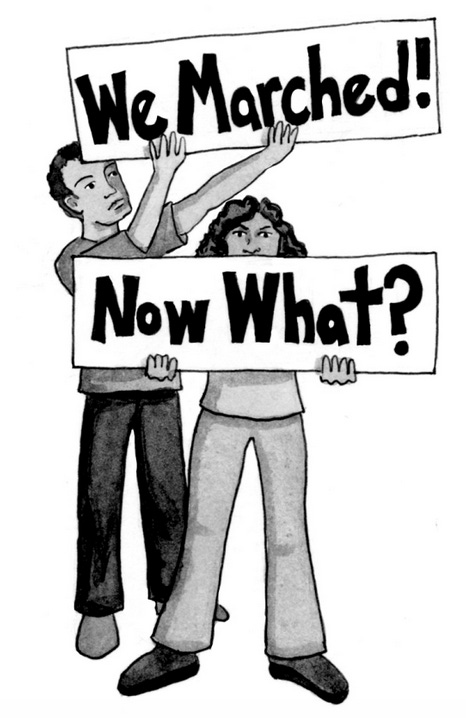
Here’s an illustrative story courtesy of Saul Austerlitz, one of the founders and long-running organizers of Brooklyn Resisters, a group with several hundred members that has been in existence since 2017. He told me, “For No Kings 2, we reached out to about 150 members who regularly participate/write in.” With the help of Megan Piontkowski, a member of the group who is an illustrator, they produced 4,000 copies of a simple “zine” titled “We Marched, Now What?” that members brought to the big Manhattan march on October 18 to hand out at the march’s end-point. As you can see, it was chock-a-block with useful follow-up information and designed to fit in anyone’s back pocket. “They went extremely quickly,” Austerlitz recalled. “One member of our group brought out some friends and they handed out 500. My 13-year-old son handed out 40 in under 10 minutes.”
I had heard about this zine in advance from an organizer friend, Joelle Asaro Berman, but also was handed one completely randomly by someone on the street. (These foldable mini-zines that can be made from a single 8x11 sheet of paper are quite the genre; here’s a whole collection made for ICE Watch efforts that Piontkowski has curated.)
For No Kings 3, Austerlitz relates, Brooklyn Resisters has done more intensive in-reach in advance of more outreach. “For this go-round, we started with the 300 or so new members that have joined us since Nov 2024, and are now going to round it out by reaching out to our longer-term members.” He said they heard from a lot of people that they hadn’t connected with “and learned more about what interests them, how they’re getting involved, or what’s keeping them from participating more.” He added that “the personal touch makes a huge difference, especially as people feel much more of a need to respond to an email/text that is clearly being sent to them specifically.” His group is currently in the process of revising and updating its No Kings 3 zine in time for March 28.
If you don’t want to make a zine to hand out, it’s simpler but equally useful to task some of your members to be greeters at your rally, with clipboards to collect people’s names and contact information, or offering them a QR code that they can scan to sign up for more information. I put a query out to Indivisible group leaders on the Indivisible Action Center Slack, asking for examples of how people were working to recruit and absorb new members. Bridget Powers, one of the leaders of Central New Hampshire Indivisible, told me, “We collect names on clipboards, hand out business cards, display QR codes and talk with people to absorb more members. Our event is promoted in our newsletter, with flyers and on social media,” adding, “You’ve made me think that we need to get members to reach out personally to friends and family.” Louise Pathe, a member of the steering committee of Indivisible Eastside in Kirkland, Washington said her group has built absorption into its monthly meetings, inviting new members to come 30 minutes early to attend a welcome/orientation session.
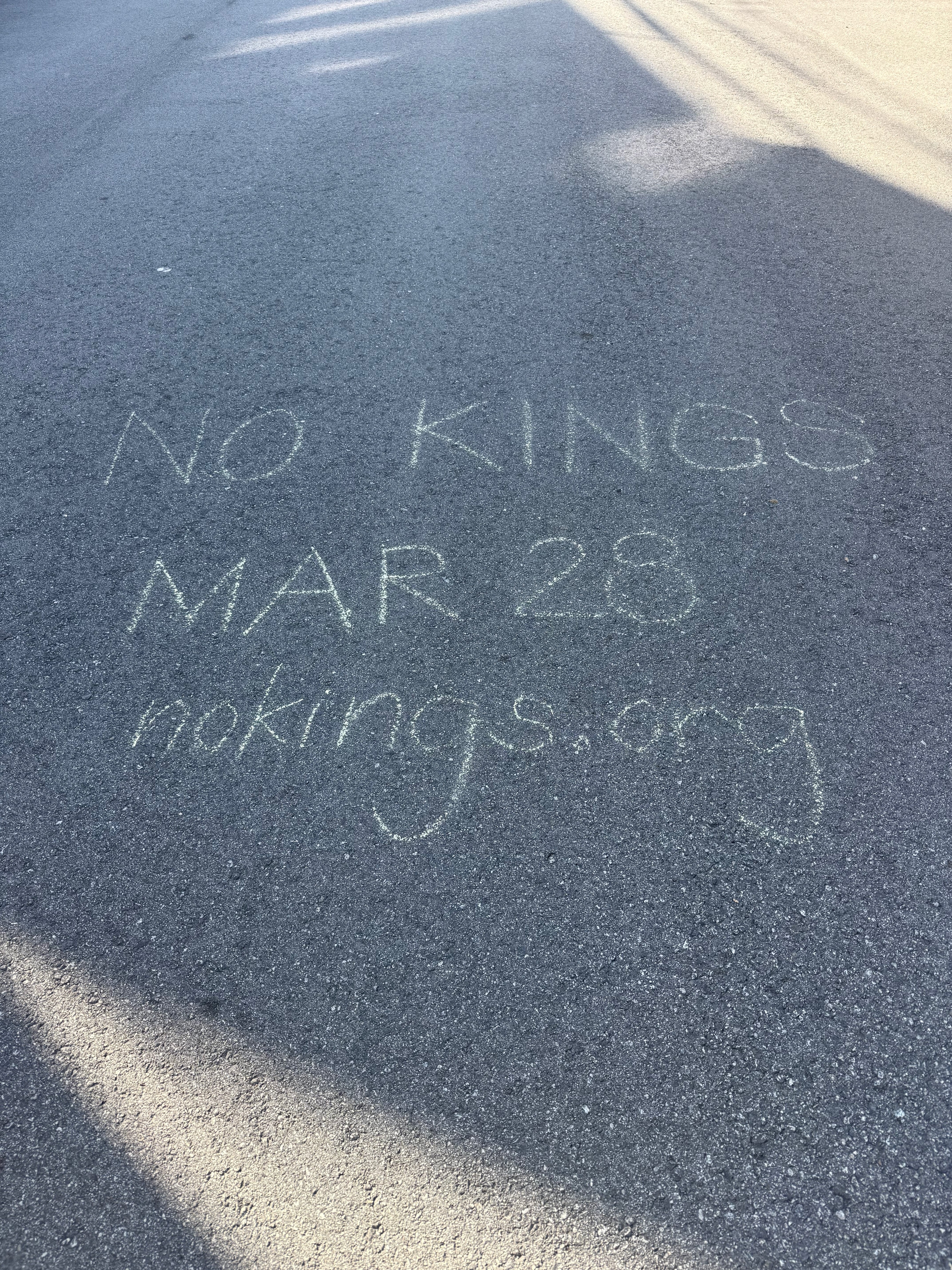
Leaders with Indivisible San Francisco are taking a variety of actions leading up to No Kings 3, including street-chalking (see below) and promoting a countdown site – NoKingsCountdown.org – that nudges visitors with small daily actions they can do throughout the month of March. (Ah, those tech-savvy San Franciscans!) Kathy Lass, one of their members, told me that their approach to absorbing new people will be focused on “giving them a concrete plan on what to do,” which will start with spreading the word in their own neighborhoods and urging them to “Participate in the May 1 shutdown, with no work, no school, no shopping.” Already, thinking ahead.
Why is the US bombing Iran (cont’d)?
I got some constructive feedback from an old friend and longtime reader who took issue with what I wrote last week about Israeli Prime Minister Benjamin Netanyahu being “the tail that wagged the dog” and part of a power-nexus including Jared Kushner and Steve Witkoff “guiding Trump’s hand.” In particular, my friend objected to my citing Secretary of State Marco Rubio’s remarks about a pending Israeli attack on Iran triggering American action, because it suggested that Israel was somehow the stronger party. So let me take another whack at the question “Why is America bombing Iran?”
The answer is not simply because Israel has wanted it. You can find that argument popping up all over the political map now, from leftist conspiracists like Sarah Kendzior to sane progressives like Ryan Cooper in the American Prospect to self-described independents like Andrew Sullivan, not to mention the far-right fever swamps. They make compelling arguments about the power of the pro-Israel lobby over Congress and the mainstream media and the role of Christian Zionist evangelicals, as well as the increasing power of expansionist, messianic and racist forces in Israeli Jewish politics. Yet none of these explain how a country of 10 million forced a much more powerful country of 330 million to throw caution to the wind and attack Iran.
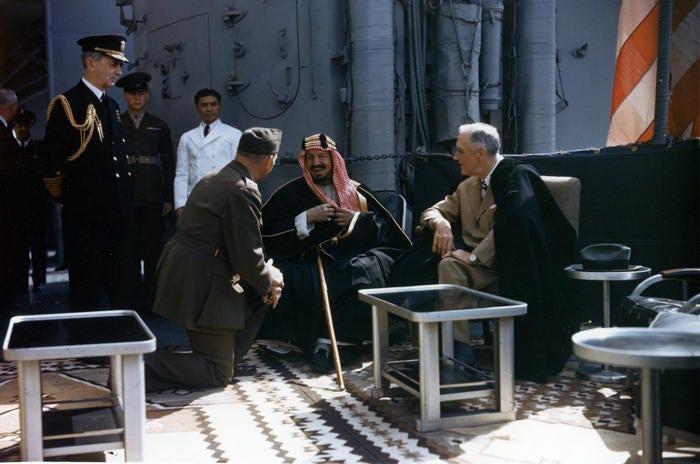
What’s missing from the picture? You can’t explain how America behaves in the Middle East without remembering the deal that FDR made with Saudi King Ibn Saud in early 1945. In exchange for the Saudis guaranteeing a reliable supply of oil to the US, America pledged to protect the House of Saud and its kingdom from any and all adversaries. And it was none other than US President Jimmy Carter who reinforced this alliance with his eponymous “Carter doctrine,” which declared that the US would be prepared to use force to protect its interests in the Gulf. Which it did during the Iran-Iraq War by keeping the strategic Straits of Hormuz open for oil shipping, and then again during the 1991 Gulf War, when American troops protected oil fields while the kingdom provided money and fuel for the US side of the war.
Saudi oil plays a key role in the global economy because it’s the only major oil power that has the ability, due to its enormous reserves, to increase or decrease production at will, allowing it to have tremendous influence over global supplies and prices. (Plus Saudi oil is very cheap to extract, compared to other sources.) And even though America is now an oil exporter, its role as guarantor of the Saudi kingdom and its oil matters a lot to countries that are heavily dependent on Gulf oil, like Japan, South Korea, India and China. Though the US-Saudi alliance faced some bumps near the end of Trump’s first term and after President Biden’s criticism of the killing of journalist Jamal Khashoggi, with the Saudis normalizing relations with Iran (thanks to help from China), the current war must be seen as a recementing of that 80-year-old relationship.
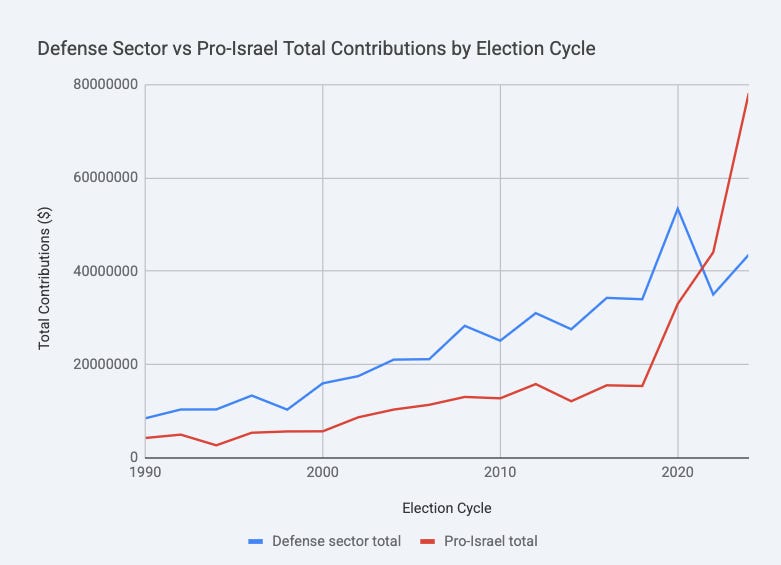
In addition, all the attention on AIPAC’s influence in Congress must be judged against the efforts of another powerful interest group that benefits greatly from America’s military adventures: the defense industry. According to OpenSecrets, which has been tracking the role of money in politics since 1990, direct contributions from defense industry PACs and executives have totaled $440 million over the last 36 years. By contrast pro-Israel groups and individuals have given $298 million. The same is true for lobbying expenditures--$3.4 billion since 1990 on behalf of defense interests compared to just $89 million by pro-Israel groups. Indeed, the 2024 election cycle is the only one where campaign contributions from pro-Israel groups ($78.1 million) has outpaced money from military contractors ($43.5 million).
America’s bloated defense sector functions as a kind of warped form of national industrial policy since slices of the Pentagon’s enormous budget fall in every congressional district, along with pay and benefits for servicemembers, retirees and veterans. This beast, which President Dwight Eisenhower called the “military-industrial complex,” needs a constant supply of global threats and adversaries to justify its existence. As Eisenhower said in his farewell speech in 1961, “This conjunction of an immense military establishment and a large arms industry is new in the American experience. The total influence-economic, political, even spiritual-is felt in every city, every state house, every office of the Federal government…. In the councils of government, we must guard against the acquisition of unwarranted influence, whether sought or unsought, by the military-industrial complex. The potential for the disastrous rise of misplaced power exists and will persist.”
My point: American bombers don’t appear over Tehran simply because it is in Israel’s interest to decimate a regime that – we should remember – has been dedicated from its start to its destruction. America’s gigantic military sector makes American leaders tilt towards making war. Its longstanding alliance with Saudi Arabia and other associated Sunni oil monarchies has made it tilt against Shia Iran (and that country’s decade-old attempt to control its own oil resources to achieve some degree of independence). And last but definitely not least, we are currently ruled by a Mad King who thinks that war is a TV show. David Rothkopf says it better than I can: “”Not since Adolf Hitler blew his brains out in a bunker beneath the garden of the German Reich Chancellery on April 30, 1945, have the lives of so many people around the world been so buffeted by the psychosis of a single man.”
If you scan Kendzior, Cooper and Sullivan’s pieces, you won’t find the words “oil” or “defense sector” or “military industrial complex,” but you will find a lot of heated rhetoric pinning the Iran war on Israel. I found Kendzior’s essay especially troubling for how it misuses investigative work by my dear departed friend Robbie Friedman, whose books and articles on American-Israeli fascist Meir Kahane and the encroachment of the Russia Mafia in America get turned, by Kendzior, into proof of not only Israel’s drive to take over the land from the Nile to the Euphrates but also of Trump’s alleged ties to Russia organized crime. I posted a comment on Kendzior’s site pointing out some of her errors and exaggerations, but to date she hasn’t replied. Seeing scholars like Jason Stanley praise her article shocked me.
Worth Chewing On
—Eric Blanc, “Why is there no anti-war movement in the US?” Labor Politics, March 9, 2026. The whole piece is very good but this paragraph stands out: “Rather than build the broadest and deepest possible opposition to US military aid and interventions abroad, too much anti-war activity in recent years has leaned into alienating, excessively radical rhetoric and slogans, while tying widely supported demands against war to unjustified and unhelpful romanticization of any and all “anti-imperialist” forces. Consistently opposing imperialism does not require justifying Hamas’s killing of civilians or the Islamic Republic’s repression of pro-democracy activists.”
—In the same vein, see Mehran Khalili, “Iran: Where’s the resistance,” Subvrt Newsletter, March 10, 2026.
—Susan Wagner, “Dear pundits: We need your assistance,” The Grassroots Connector, March 9, 2026. Her message to the daisy chain of TV talking heads like Nicole Wallace, Tim Miller, Jen Rubin, Jon Favreau, Chris Hayes, and Katie Phang: “You have created an echo chamber. Every week the same experts make the rounds with the same anxiety-provoking messages. This leaves listeners with an incomplete picture of the political landscape.”
—Put the phrase “escalation trap” on your radar, and listen to what military expert Robert Pape has to say about how air power has never toppled a regime by itself, and how the result of a foreign power bombing an unpopular regime is to change domestic politics, make everyone more nationalistic, and “fuse the society and regime closer together.” See “Iran and the escalation trap,” CBC radio transcript, March 5, 2026.
End Times
If you remember this mind-blowing video by Michael Wesch from 19 years ago about how the Internet was going to change everything, watch what Claude Opus 4.6 made after researcher asked it to “express what it’s like to be a LLM.”
Once again we are on the same page. Here is an article I published in the Grassroots Connector about helping people to get involved and stay involved. The cards mentioned in the article are now available in Proshop- Resources For Resistance, Linktree Business Card. They have proven very helpful. https://grassrootsconnector.substack.com/p/my-new-years-resolution?utm_campaign=post&utm_medium=email
I think it was Chris Murphy who said today, in response to Trump’s statement that we are not going to secure the nuclear material in Iran, then what the …. Are we doing there? Not that Murphy was in support of such a venture but this could be the only legitimate motivation. How does this war not create a failed state with millions of people suffering its toxic effects?