
Introducing ProDemStack: An Interactive Network Map of Pro-Democracy Substacks
Fish need to be their own oceanographers. So building on my post 2 weeks ago about the "bad news echo-chamber," here's a deeper dive into the tilt and dynamics of the pro-democracy Substack ecosystem.

This morning, Heather Cox Richardson, the author of the highly popular daily Substack “Letters from an American” (2.9 million subscribers), focused on President Trump’s increasingly unhinged threats against Iran, suggesting that he was “considering using tactical nuclear weapons.” Former Clinton Labor secretary Robert Reich (1.1 million subscribers) chose to speculate about which cabinet official Trump would fire next. The never-Trumpers at The Bulwark led the day with a post calling for resistance within the executive branch and for Trump to be impeached again. Podcast Meidas Touch’s Ben Meiselas (908,000) amplified Trump’s threats and then mostly attacked the New York Times for making them sound “relatively normal.” Drop Site News (753,000) headlined a story by its lead reporter Ryan Grim on how the Iran War was causing Gulf countries to review their investments in America. Legal expert Joyce Vance, whose Civil Discourse newsletter has 615,000 subscribers, also led with Trump’s “Open the Fuckin’ Strait” post and then went down the rabbit hole that is the Justice Department’s Civil Rights Division. Former MSNBC host Katie Phang (601,000) shared her revelation that “Convicted Felon Donald Trump is unfit, unkempt, and unfortunately the President.”
It was another typical day across the most popular pro-democracy Substacks: gloom, doom, outrage, and restating the obvious, with a smattering of fresh reporting of more bad news. Nothing about how we are organizing to resist all this madness. Just a week earlier, millions of Americans had just marched in opposition, but you wouldn’t know it from these sites.
Two weeks ago, I wrote a post here titled “The Bad News Echo-Chamber of Pro-Democracy Substack.” It got a decent amount of attention, including a generous endorsement from Robert Hubbell, whose Today’s Edition newsletter (55,000+) I had noted was one of the leading sites offering readers lots of hope and practical ways to resist. Clearly, I struck a chord, but to be honest, I wasn’t very happy with that post. I centered a small group of authors who I happen to regularly follow, rather than scan the whole ecosystem. And I chose a metric—co-appearances on Substack Live—that was bound to overstate the clubbiness of this group.
So, with the help of Claude Cowork AI, I did a much deeper dive. I started with a seed list of about 140 sites helpfully provided by Deepak Puri of DemocracyLabs. Then I culled out sites that weren’t text-focused (some just share cartoons or videos) or appeared to be dormant. I also took out sites that operate and look like traditional news magazines, not because they don’t do good work, but because I wanted to zero in on the Substack ecosystem and a key sign of attention-sharing that nearly everyone on that platform uses and benefits from: recommendations. After a first pass collecting recommendation data from those initial sites using Substack’s API, I built out a larger list of 236 in all and asked Claude to map and cluster them based on who recommends who from within that defined set.
The result is now a live, interactive network map located at ProDemStack.netlify.app.
The map does a few additional things:
-It sorts sites by tone into those that focus on alarming readers, those that are neutral, and those that focus on action. Visually, those on the red/orange/yellow spectrum are more alarmist while those on the green/blue spectrum are more activist.[1]
-It clusters sites that recommend each other near each other.
-It shows sites’ subscription data (where available) or follower data (as a fallback) and visualizes that by the size of each site’s bubble on the map. The median number of subscribers across the roughly two hundred that make this data public is 37,000.
-It also offers an alternate view of the network sizing sites by how many other sites recommend them.
-It shows more specific data for each site, which you can find by searching by its name or clicking on a particular node.
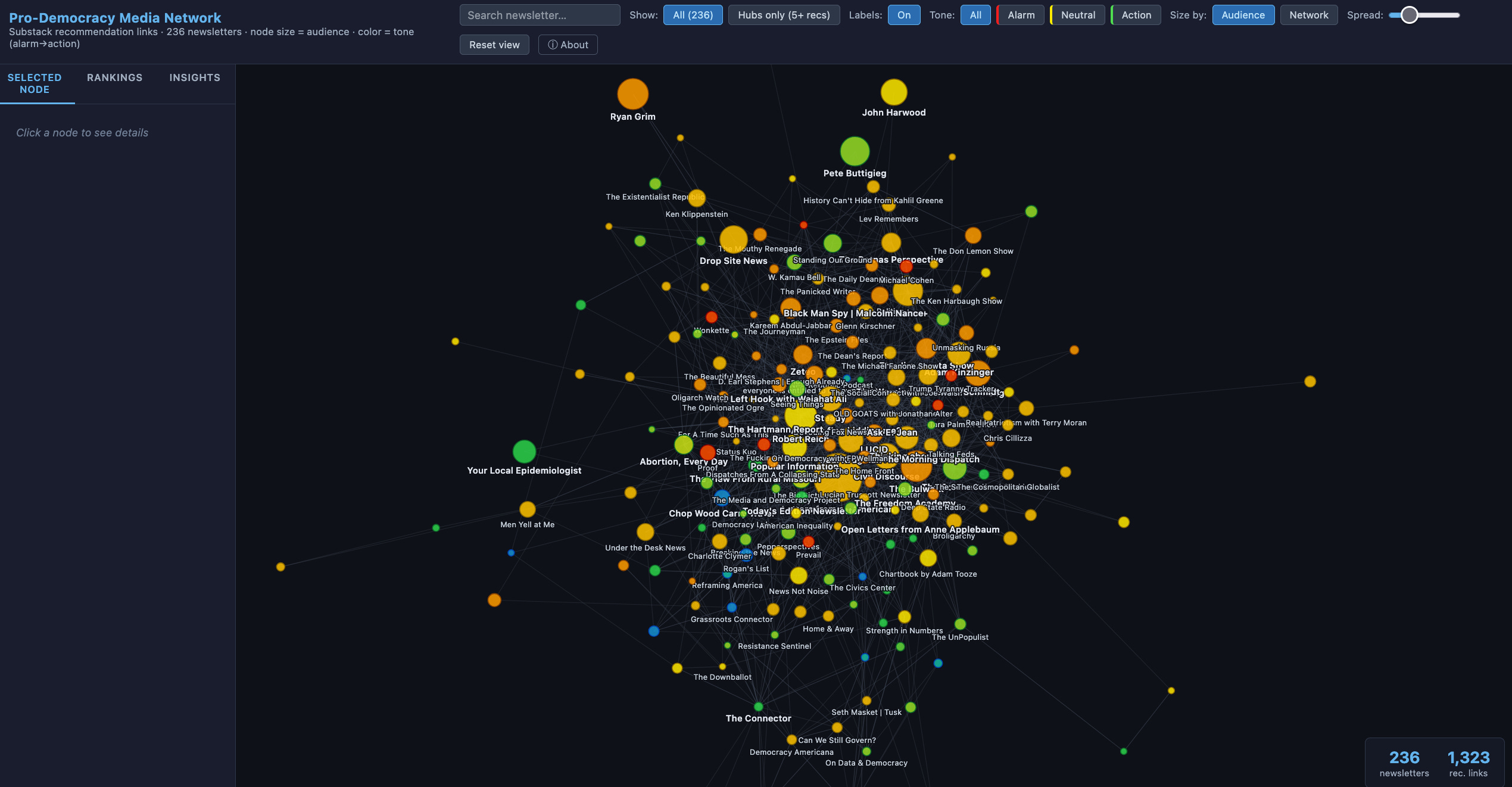
This is a snapshot of an ecosystem as it has evolved to the current moment in time. It no doubt contains errors of omission and commission, which I’ll gladly try to correct as I hear about them. It’s using a blunt signal--who recommends whom—which can mean different things to different users. A newsletter might recommend another publication for many reasons—ideological alignment, personal friendship, audience overlap—but the map treats all recommendations as equivalent. Recommendations also change. Audience counts are approximate and may lag actuals. And tone scores are inherently subjective.
What Does All This Show?
The pro-democracy media network on Substack is dominated by alarmism. You can see this if you compare the size and density of the alarm group to the action group. Fifty-seven percent of the sites mapped scored in the 1-4 range as somewhat to highly alarmist. Just thirty percent scored in the 6-9 range as somewhat to highly action-oriented. You might argue that this is appropriate to the times, after all, the world is on fire and arsonists are in charge. But there’s no evidence that feeding people a steady diet of fear, loathing, outrage and terror convinces them to get more engaged in defending what’s important and fighting back. Rather, the pro-democracy ecosystem on Substack becomes another mirror of the algorithm-driven worlds of social media, which drives attention towards emotional spectacles and heightened fear of people not from our in-group.
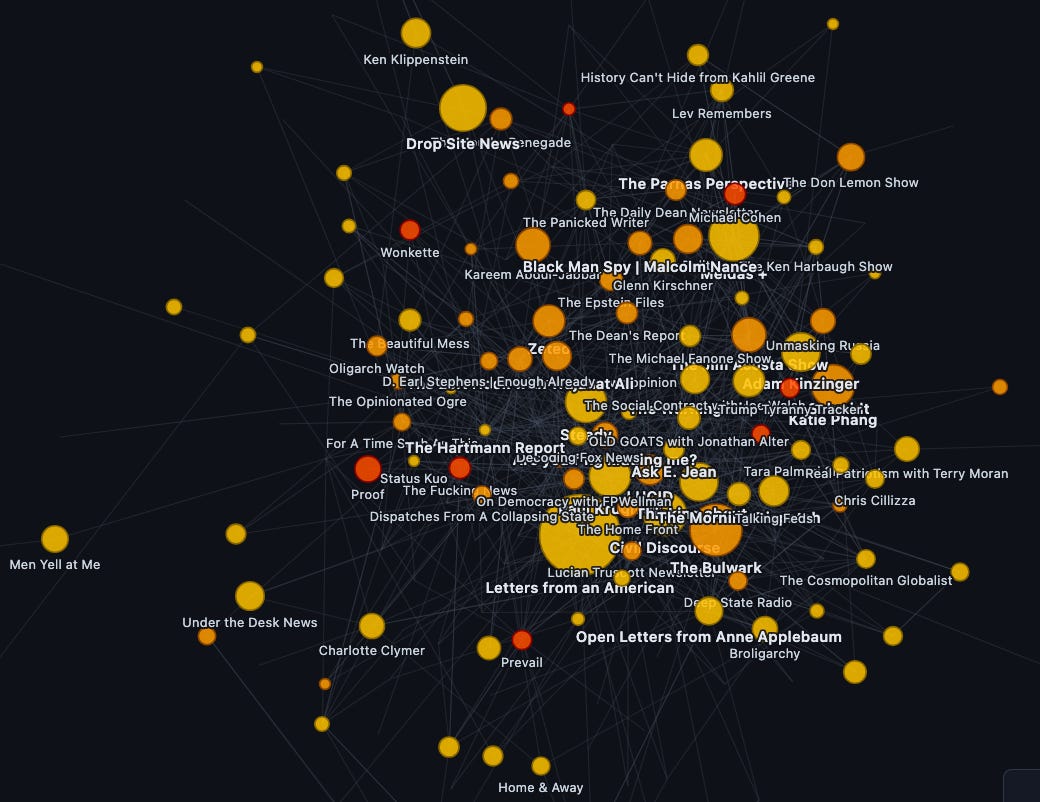
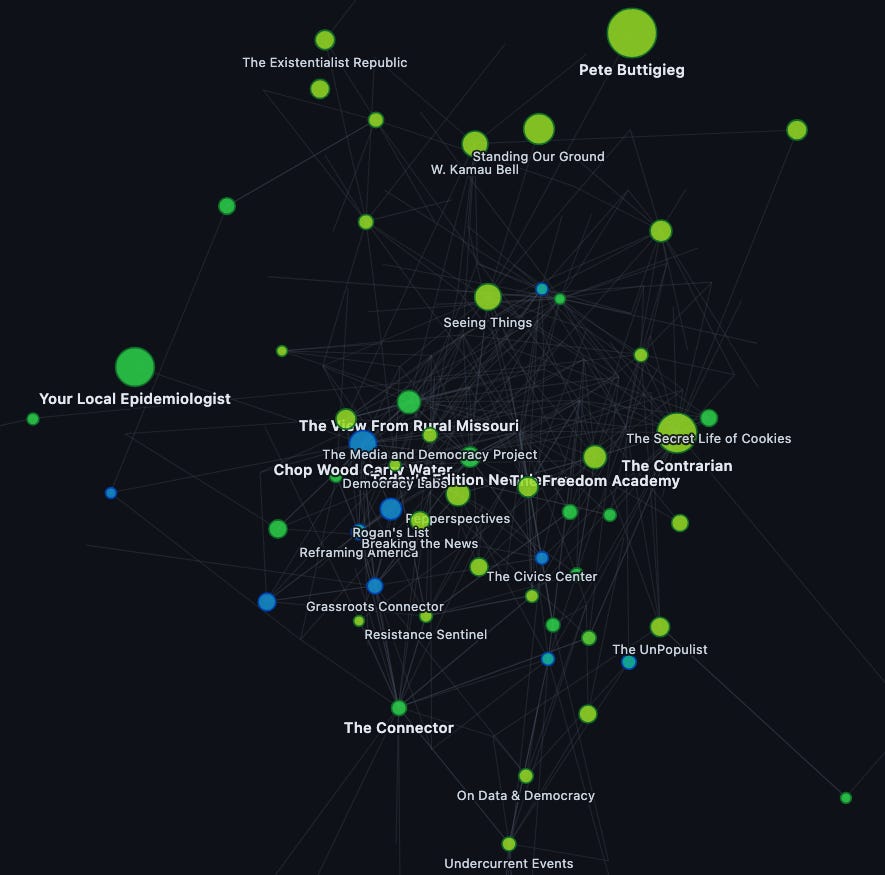
The data also shows that the way sites share attention across the whole network tilts toward alarm over action. Action-oriented sites make nearly twice as many recommendations of alarm-oriented sites, despite being a much smaller group overall. Action-oriented sites also tend to be more generous with their recommendations, while many alarm-oriented sites are stingier. Sites with bigger followings also tend to be less willing to recommend others, reinforcing the “winners take all” dynamic I noted two weeks ago.
As I argued in my earlier post, I believe this tilt isn’t helpful. It builds and reinforces a public that is dumbed and/or beaten down by an overwhelming flow of bad news, rather than one that is informed and/or uplifted by all the concrete actions people are taking to push back and save our democracy. It also tends to reinforce a star-system centered on a chattering class of cable-news-famous talking heads rather than organizing leaders. And it incentivizes behavior that gets clicks and sells books rather than behavior that moves resources to power-building. At its worst, it becomes a self-licking ice-cream cone, the more a small group of skilled doom-talkers feature each other on their daily shows while ignoring the compelling work of lesser-known but incredibly valuable community leaders.
But Wait, There’s More
After doing this analysis, I asked Claude to help me figure out one more thing: the main topics that top alarm sites focus on compared to top action sites. I did this partially to see if the coding decisions that I had made about editorial tone would be corroborated by the words that got the most usage in site headlines. So Claude scraped about 1200 headlines from the top 25 sites in each category, working backwards from now, looking for the 50 most recent titles per site (max). Then it produced the following word-cloud graphic. Stopwords like “and” and “the” were excluded as well as dates and brand names. And since Trump landed at the center of both sites by frequency alone, we removed him from both clouds to make other topics more visible.
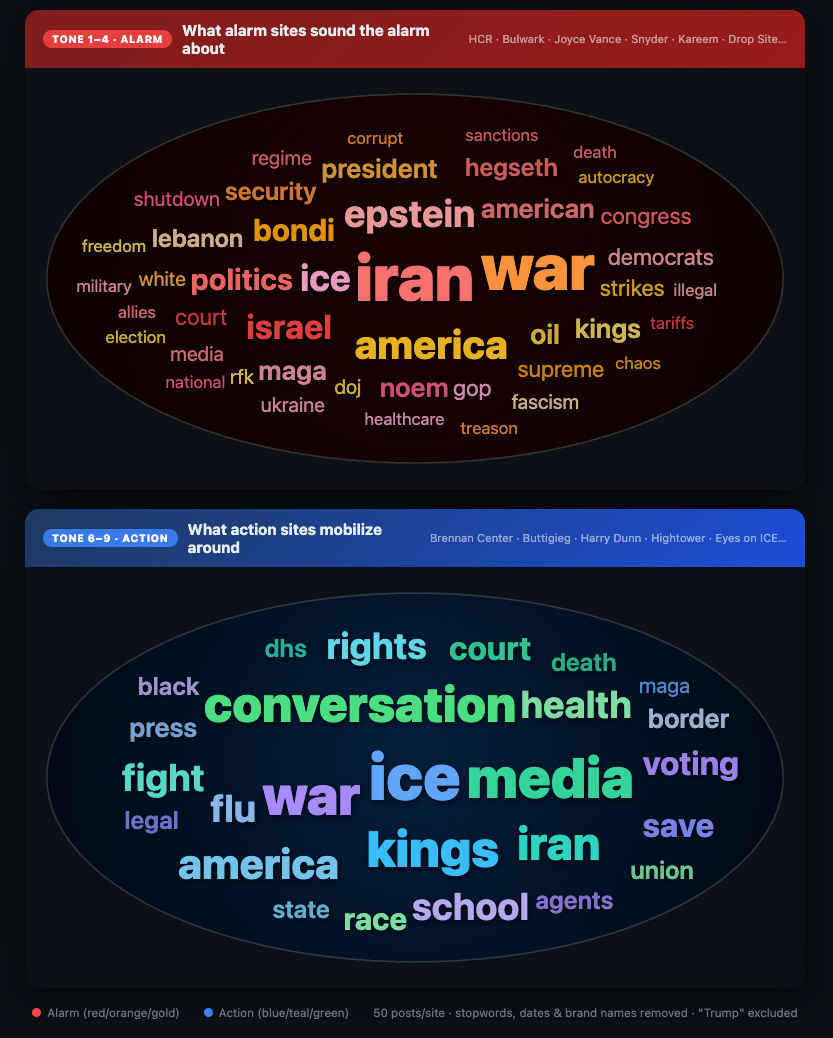
As you can see, there are important overlaps and differences. The Iran War and ICE are both prominent, but alarm sites are more focused on the former while action sites are paying greater attention to ICE. This may be in part because there’s more we can do about ICE right now. Alarm sites pay more attention to the more outrageous members of the Trump regime, and they use scary words like fascism, treason, death, treason, illegal and chaos more often. Action sites appear more attentive to the need to engage fellow Americas, using words like conversation, media, rights, voting, school and elections more often. And finally, no surprise, action sites are far more likely to reference kings (as in No Kings) compared to alarm sites.
As I concluded two weeks ago, this picture is not locked in stone. The people who helm these sites can adjust their coverage. Their many subscribers can also push their favorite authors to shift their horizons, or they can vote with their cursors and wallets to support other sites. Cut back on the money you give to Substack stars who dwell too much on the cheap production of gloom and doom and shift your dollars to sites that really cover what’s happening on the ground.
Footnote: This is my first experiment vibe-coding and it won’t be my last. Claude initially impressed me with how quickly it figured out how to execute on my ideas for this map. But over time, the quality of its work got worse, making mistakes that I needed to correct and charging me multiple times for extra usage as a result. This could just be my bad luck, timing-wise, as Anthropic, Claude’s owner, is in the middle of a very heated battle for mindshare with platforms like OpenAI’s ChatGPT, and my little project may have been buffeted by shifts in which clients Anthropic wants to favor. That is, it may have been giving individual users a souped-up experience in recent months to get them to get their bosses to pay for much more expensive corporate accounts, and now, seeing lots of those bigger users signing up, shifting compute power towards them and away from the little guys. Either way, despite the hiccups, I’m still intrigued by the power of these tools.
—Related: Nate Silver’s take on the political media ecosystems of Twitter/X (“extremely right-leaning” and “incredibly low quality”), Substack (“dominated by Resistance Lib publications”) and Bluesky (“fairly predictable” “mostly reasonably prominent left-progressives”) is worth looking at, if you want another intelligent point of view on all of this.
Duly Noted
—Great stuff here from Deborah Asberry of Hoosiers For Democracy in Indiana on how they have developed a conceptual model for building a resilient statewide volunteer network and dealing with the otherwise endemic problem of “too few people doing too many things.” Read the whole thing.
—Is the political industry “about to die”? So predicts Daniel Barkhuff, who is behind a start-up called Civly that he believes is going to undermine most of the business of oppo research, communications, debate prep and rapid response. No question that the industry is being disrupted by AI, but I suspect rather than dying, it’s going to just get reshuffled.
—Shame on the NY Times for front-paging a fluff story about a one-man billion-dollar business start-up built with the help of AI. The Times piece left out the fact that Medvi, the GLP-1 sales platform in question, received an FDA warning letter in February for misbranding violations, is facing a class action lawsuit, and exposed months ago for using deep-faked photos of patients and creating hundreds of fake doctor accounts on Facebook to promote its wares.
—Am I the only person who wonders if Defiance.org is a grift?
End Times
This is diabolic.
[1] This was done by Claude computationally reviewing the language used in post titles and then assigning a score from 1 (most alarmist/doom-and-gloomy) to 9 (most action-oriented), followed by my own manual review of those scores based on my own knowledge and experience of those sites. High-alarm sites (1-2) are those that focus primarily on warnings, crisis and threats while offering minimal actionable content. Alarm-leaning (3-4) focus significantly on threats and accountability, with some action content. Neutral sites (5) tend to provide traditional journalistic reporting and showed no strong lean. Action-leaning (6-7) sites have a regular emphasis on organizing, strategy and democratic participation. Highly-action oriented sites (8-9) primarily focus on mobilization, civic power-building and concrete solutions.
Micah Sifry has performed a service for those of us who believe in ACTING, not agonizing. His ProDemStack tool maps out the tendencies of 236 Substack sites identified as pro-democracy. The resistance movement needs more and deeper coverage, and the same old Trump tropes deserve less repetition. We already know what he said and did. Of greater interest: What are WE doing?
Micah - I'm glad you are pointing out the futility of gloom and doom articles. There is also an epidemic of them on Facebook. I like your plan to steer readers towards more Action sites by restocking and promoting those sites.
Another tactic: Have you ever spoken directly to any of the authors of the Alarm sites ?? Could they be convinced to become more Action oriented ??