
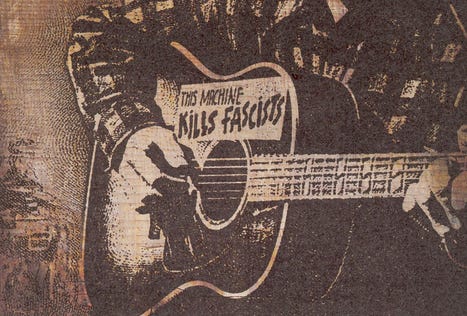
This Machine Quells Fascists
All across the nation, there's a new vibration, spreading from Minneapolis and traveling at the speed of song.

Last week, over the course of two nights, about six thousand people logged into a Zoom seminar to learn how to join Singing Resistance, a grassroots network of local groups showing up in the streets, at faith centers, and outside ICE buildings to sing out against rising authoritarianism. On the weekend of February 28/March 1, we will see the first fruit of their efforts. My gut tells me this could be big.
Why? First, because singing together is something many people already like to do. And it’s self-reinforcing. As musician Brian Eno, who has participated in a weekly a capella group for more than twenty years, has said, singing aloud isn’t just good for your lungs. “There are psychological benefits, too: Singing aloud leaves you with a sense of levity and contentedness.”
But even better, Eno told NPR, “…then there are what I would call ‘civilizational benefits.’ When you sing with a group of people, you learn how to subsume yourself into a group consciousness because a capella singing is all about the immersion of the self into the community. That’s one of the great feelings — to stop being me for a little while and to become us. That way lies empathy, the great social virtue.”
The second reason why Singing Resistance is going to take off is because its lead organizers are choosing to spread new and simple songs that anyone can learn quickly. At first, as I listened to their trainers sing a few of these songs, I thought – why aren’t they doing to old movement standards, like “We Shall Overcome” or “This Little Light of Mine.” But then the answer was obvious—when older folks who grew up with those songs start with them, younger people feel like they’re at someone else’s nostalgia party. Building a new songbook—one that doesn’t reject the old songs but also doesn’t lead with them—makes it easier for everyone to join as equals.
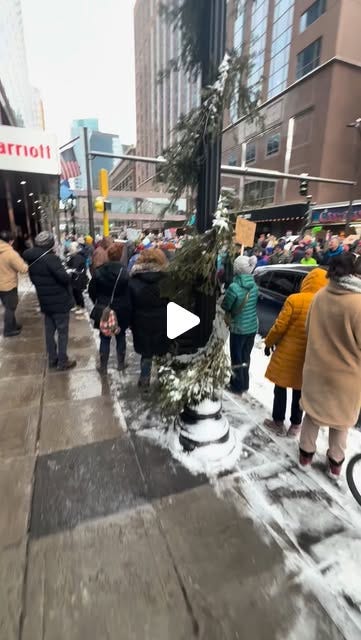
And you can see that this approach is working, judging from the videos of Singing Resistance events in and around Minneapolis, where the nascent movement first took wing (after an earlier incarnation organizing “Ceasefire Choirs” in response to the carnage in Gaza). Young, middle and old are marching together.
The third reason this is going to spread is because a crowd of a few hundred or thousand people singing together is a vastly more contagious activity than a crowd chanting angry protest slogans and cliches, or a crowd straining to hear what one speaker up front is saying. Beyond turning a crowd into a choir, singing also taps and releases deep emotions, be they grief or love, and builds bonds among strangers.
Group singing also reaches passive listeners at a different register than shouting or jeering. So far, there’s no evidence that any ICE agents have decided to turn in their face masks and quit after being serenaded by a group of Resistance Singers, but it stands to reason that a gentle song promising them that it’s OK to change their minds is going to linger, even if just as an ear-worm, far longer than raucous rants.
Lastly, I think Resistance Singers is going to spread because of how well its organizers set up their training Zooms. In advance of these mass calls, they circulated a well-written toolkit and songbook, and urged expected attendees to not only do the reading in advance, but to make sure they created Signal accounts so they’d be ready by the end. At the end of the meeting, they posted a link to a list of Signal groups, one for each state. In just a few minutes, thousands of people self-sorted. Being from New York, I joined that Signal group, and then watched as a couple hundred people signed in. But then something even more useful happened—after declaring their locations, people started sharing links for more local Signal groups. I saw groups for Brooklyn, Buffalo, Central NY, the Capital District around Albany, Delaware County, Great Neck, Long Island, Mid-Hudson, NYC, and Westchester. Now, instead of being an anonymous mass, people are in small groups who live near each other: the perfect building block for effective action.
The real test will be the weekend after next, which Resistance Singers has called a “nation-wide day of singing actions.” On Instagram, I counted 40 local groups, including Albuquerque, Atlanta, Austin, Bucks County, Charlotte, Chattanooga, Chicago, Chi_NWBurbs, Cincinnati, Corvallis, Decorah, DC, Denver, Evansville, Fort Worth, Grand Rapids, Greensboro, Indianapolis, Ithaca, Knoxville, Madison, Marin, Missoula, Northfield, North NJ, Oklahoma City, Orlando, Olympia, Philadelphia, Portland, Raleigh-Durham, Salt Lake City, Savannah, Seattle, Sioux Falls, Sonoma County, St. Louis, Tacoma, West Michigan Lakeshore, Ypsilanti, and Yuma. Some of them have already held their first public actions, including Chicago and Indianapolis.

If there’s anything that could stunt the spread of Singing Resistance, it’s the linguistic tics that some of its organizers seem wedded to. Some people love land acknowledgements and the academic verbiage that many college educated radicals use. Others (like me) cringe. But honestly, I don’t think this is likely to matter much, because the songs Singing Resistance is spreading speak louder and better, and because people need a way to channel rage into loving action.
Assuming the February 28/March 1 weekend of action goes well, there’s a lesson here for all the groups currently holding mass Zoom calls. If you are gathering thousands or tens of thousands of people on a call and then NOT offering them a way to find their nearby neighbors by the end of the meeting, you’re leaving power on the table untapped. (You know who you are; I’m being kind not pointing fingers.)
Related Reading
—Paul Engler, “Why Movements Need to Start Singing Again,” In These Times, January 4, 2023.
—Garrett Bucks, “Seven reasons why hosting a silly little potluck (or game night, or porch hang, or book club, or group hike) is essential to defeating fascism,” The White Pages, February 3, 2026.
—Dakota Hall, “The Fun Deficit: Why the left keeps losing young people before they even show up,” The Ground Game, February 4, 2026.
End Times
Now, imagine if this guy joins in.
In the first days of the Covid pandemic, Italians in the norther towns came out onto their balconies in the evening to sing together. Pretty magical.
lets start this in Westchester! I downloaded the songbook; ben and I will hop on FB live...